In the competitive world of kitchenware, the material you choose defines your brand’s reputation for quality and safety. While glass is the gold standard for sustainable storage, not all glass is created equal.
Today, we see a massive market shift: global buyers are moving away from traditional Soda-Lime glass in favor of High Borosilicate glass. But what is driving this change, and borosilicate glass vs soda lime glass, which material is right for your product line? This guide breaks down the science, the performance, and the business logic behind the two.
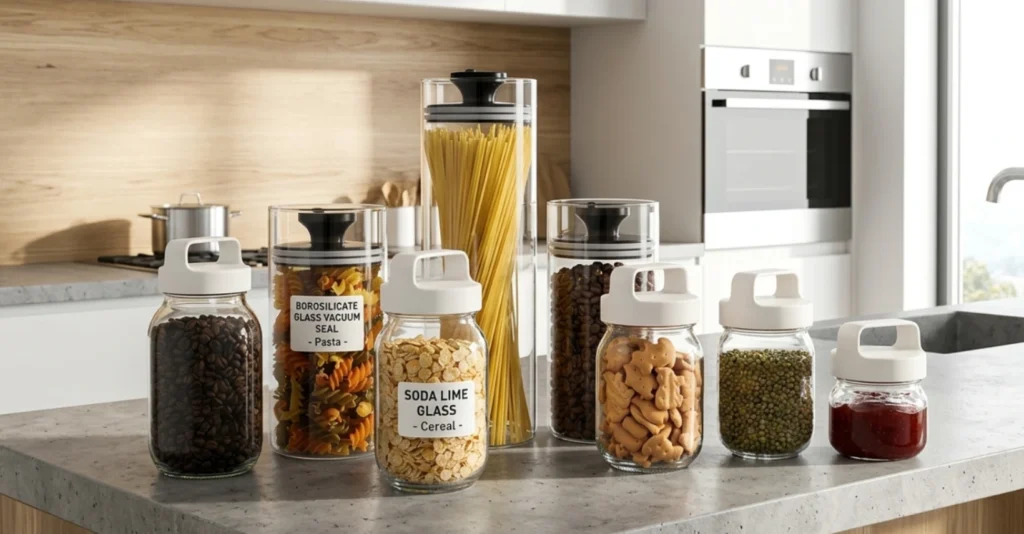
The Chemistry: What’s the Difference between?
What is High Borosilicate Glass
High borosilicate glass is a type of borosilicate glass mainly composed of silicon dioxide (SiO₂) and boron trioxide (B₂O₃). Its core feature is an extremely low coefficient of linear thermal expansion, approximately (3.3±0.1)×10⁻⁶/K, and thus it is often referred to as “borosilicate glass 3.3“.
Boron trioxide (B₂O₃) is a key raw material for making heat-resistant glass (such as laboratory vessels, high borosilicate glass cookware for kitchens), instrument glass, and optical glass. Adding B₂O₃ can significantly reduce the coefficient of thermal expansion of glass, enabling it to withstand drastic temperature changes without cracking. Besides, B₂O₃ not only regulates the viscosity in the molten state, facilitating processing, but also enhances the chemical stability and mechanical strength of the glass.
What is Soda Lime Glass
Soda-lime glass material is a kind of amorphous inorganic non-metallic material. Its main chemical composition is silicon dioxide (SiO2). It is usually made from main raw materials such as quartz sand, soda ash (sodium carbonate), limestone, etc., through high-temperature melting, shaping, and annealing.
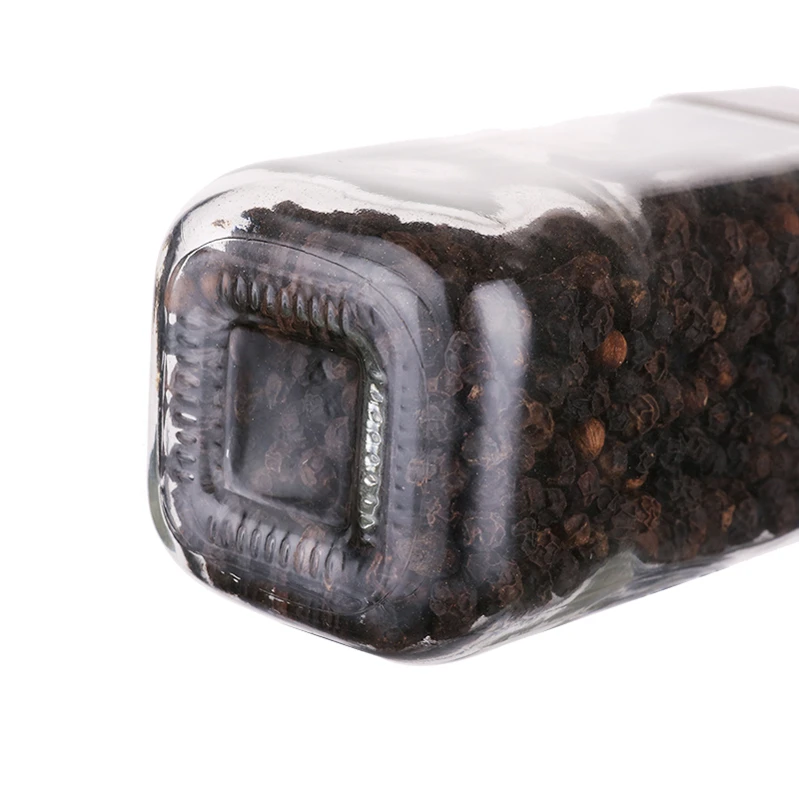

Key Difference Between Borosilicate Glass vs Soda Lime Glass
| Feature | High Borosilicate Glass | Soda-Lime Glass |
| Thermal Expansion | Extremely Low | High |
| Thermal Shock Resistance | Excellent (Up to 120°C shift) | Poor (Risk of cracking >40°C shift) |
| Temperature Range | -20°C to 400°C | 0°C to 60°C |
| Chemical Durability | Highly resistant to acid and scratches | Often has a slight “green tint.” |
| Weight & Feel | Lighter and more refined | Heavier and bulkier |
| Optical Clarity | Crystal clear; premium look | Often has a slight “green tint” |
| Production Cost | Premium | Economical |
Application Guide
The performance differences directly determine their application fields.
- High borosilicate glass: Applied in fields with strict performance requirements.
- Soda-lime glass: Applied in cost-sensitive fields where performance requirements are not high.
Kitchen & Cooking
High borosilicate glass: Suitable for heavy-duty kitchen utensils, heat-resistant cookware, oven-safe dishes and microwave containers. Due to its extremely low coefficient of thermal expansion, it can withstand rapid temperature changes (e.g., from the fridge directly into a preheated oven) without shattering.
Soda-lime glass: Suitable for general-purpose kitchenware, like simple storage jars, spice jars, and oil bottles. Due to its lower heat resistance, it is unsuitable for oven and microwave use. This glass is very sensitive to thermal shock, it can easily crack or shatter if boiling water is poured into it.
Drinkware & Tea Sets
High borosilicate glass: Pour-over coffee carafes, delicate tea infusers, double-walled insulated mugs, etc. It feels lighter and brighter. Because of its lighter, thinner, and chemically stable nature, it will not leach chemicals or retain odors, ensuring the purest taste for the beverages.
Soda-lime glass: water glasses, etc. It feels heavier and more substantial.
Industrial & Laboratory
High borosilicate glass: Beakers, test tubes, reaction vessels, etc. Beyond heat resistance, it offers superior resistance to acid, alkali, and corrosion, making it the gold standard for chemical experiments.
Soda-lime glass: Window panes, flat glass, inexpensive mass-produced containers. It is cost-effective and easy to mold in large quantities, making it suitable for construction materials where special physical properties aren’t required.
Why High Borosilicate Glass is Becoming the Top Choice for Global Consumers?
For food storage brands, switching to Borosilicate isn’t just a design choice—it’s a risk management and marketing strategy.
Superior Safety Standards
Soda-lime glass is prone to stress-induced shattering when exposed to sudden temperature changes (like pouring boiling water or taking it directly from the refrigerator to the oven). With an extremely low thermal expansion coefficient, high borosilicate glass can withstand a thermal shock of about 120°C, significantly reducing the risk of accidental burns. Investing in high borosilicate reduces customer complaints about breakage.
Eco-friendly & Sustainability
Due to its high resistance to wear and corrosion, high borosilicate glass’s lifespan is several times longer than that of soda-lime glass. Reducing the frequency of replacements means less resource waste, aligning with today’s trending green and sustainable lifestyles. Besides, using high borosilicate glass can reduce the replacement costs for end-users.
Lightweight & Highly Transparent in Appearance
High borosilicate glass is lighter than soda-lime glass. Its superior light transmittance makes liquids appear crystal clear, significantly enhancing the visual aesthetics of a modern home.
Partner with EasyLife: Your Glassware Experts
Choosing the right material is only half the battle; you also need a manufacturer that understands your brand’s DNA. EasyLife specializes in high-quality Borosilicate solutions for global food storage brands.
We have witnessed many business turning points for our clients and have a very acute sense of their pain points. We provide more than just products—we provide OEM/ODM solutions to help you stand out:
- Precision Customization: Tailored shapes and sizes for unique storage needs.
- Brand Integration: Professional laser engraving, silk-screen printing, and decal options.
- Premium Packaging: Custom-designed gift boxes that protect the product and enhance the unboxing experience.
With deep industry expertise, we guarantee lead times and superior quality control.
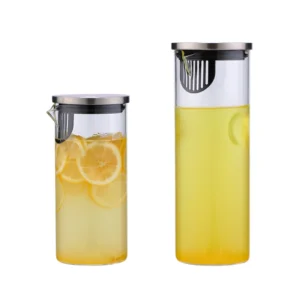
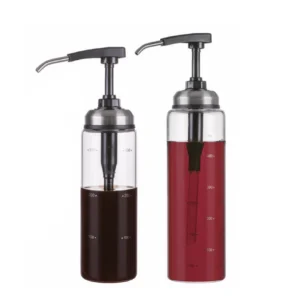
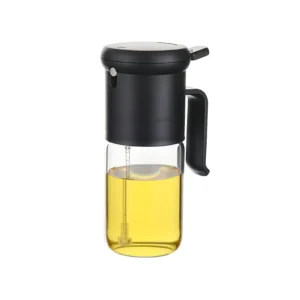
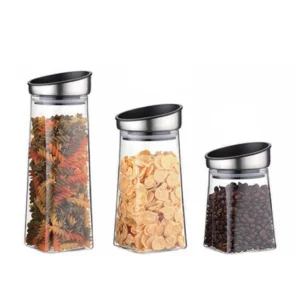
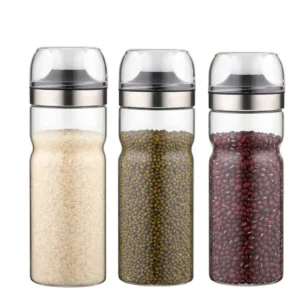
High Borosilicate Glass Products
The Final Verdict: Which Glass is Better for You?
Choosing “the best” depends entirely on your brand’s market positioning and the intended use of the product.
Choose High Borosilicate Glass if:
- Safety is your #1 priority: You want to minimize the risk of thermal shock breakage.
- The product is “High-Performance”: Your containers are marketed for microwave, oven, or freezer use.
- You are a Premium Brand: You want a lightweight, crystal-clear aesthetic that justifies a higher price point.
- Longevity matters: You want a product that won’t get “cloudy” or scratched after many dishwasher cycles.
Choose Soda-Lime Glass if:
- Cost is the primary driver: You are producing mass-market, budget-friendly items.
- The use case is “Ambient”: You are selling simple spice jars, decorative vases, or countertop canisters that will never be heated.
- Weight is a “Feel” Factor: Some customers prefer a “heavy” feel for simple water glasses to make them feel “sturdy.”
FAQ about Borosilicate Glass vs Soda Lime Glass
Is soda lime glass toxic?
No, soda-lime glass is not toxic and is generally considered safe for food and beverage contact. It is an inert, non-porous material, meaning it does not leach harmful chemicals like BPA, phthalates, or lead into your food under normal conditions. However, it is chemically less stable than high borosilicate glass; over long periods of heavy use or exposure to acidic substances, it can develop surface “clouding” or microscopic corrosion. While this isn’t a safety hazard, it can affect the clarity and hygiene of the container over time, which is why brands focusing on “medical-grade” purity often prefer borosilicate.
Can Soda-Lime glass be used in the oven?
Generally, no. Soda-lime glass has a high thermal expansion coefficient. If you take a soda-lime container from the fridge and put it in a preheated oven, the rapid temperature change (thermal shock) will likely cause it to shatter. High Borosilicate is the only safe choice for oven-to-table products.
Is Borosilicate glass heavier than Soda-Lime glass?
Actually, it is lighter. While Borosilicate is more durable, it is less dense than soda-lime glass. This allows manufacturers to create thinner, more elegant walls that are still stronger than thick, heavy soda-lime glass.
Why does Soda-Lime glass sometimes look green?
This is due to iron oxide impurities. High Borosilicate glass uses more refined raw materials, resulting in a “crystal clear” look with superior light transmittance, which makes the food inside look more appealing.
Is High Borosilicate glass BPA-free and food-safe?
Yes. Both types are generally BPA-free, but Borosilicate has higher chemical stability. It won’t react with acidic foods (like tomato sauce) or leach chemicals over years of use.
Conclusion
Choosing between high borosilicate glass and soda-lime glass depends on your specific usage scenario, budget, and other requirements. Soda-lime glass serves its purpose in basic daily applications and offers a cost-effective solution for general-purpose uses. High borosilicate glass represents a significant leap in material safety and durability. Its superior thermal resistance, chemical stability, and crystal-clear aesthetics make it the gold standard for modern kitchens, laboratories, and premium drinkware.
Understanding the key differences between high borosilicate glass and soda-lime glass in terms of composition and performance can help you make better product choices. At EasyLife, we are committed to providing high-quality glass solutions that meet the diverse needs of our customers.