When sourcing glass products such as glassware, bottles, jars, and containers, buyers often encounter quality terms such as AQL 2.5/4.0 during production inspections.
But what does AQL actually mean? Does AQL 2.5 mean that 2.5% of products can be defective?
The answer is no.
AQL (Acceptable Quality Limit) is a statistical sampling inspection standard used to determine whether a production batch meets agreed quality requirements. It does not mean that a fixed percentage of defective products is automatically acceptable.
Instead, AQL provides a common quality language between buyers and suppliers by defining acceptable defects, unacceptable defects, and inspection expectations before mass production begins.
What Does AQL 2.5/4.0 Mean in Glassware Inspection?
In glass manufacturing, defects are generally classified into three categories:
| Defect Category | Typical AQL Level | Definition |
| Critical Defects | AQL 0 | Safety-related defects that may make the product dangerous or unusable |
| Major Defects | AQL 2.5 | Defects affecting function, performance, or customer acceptance |
| Minor Defects | AQL 4.0 | Small cosmetic imperfections with limited impact on appearance |
A typical glassware inspection requirement may include:
- Critical Defects: AQL 0
- Major Defects: AQL 2.5
- Minor Defects: AQL 4.0
The actual acceptance quantity depends on the sampling plan, inspection level, and production lot size according to the agreed inspection requirements.
Understanding Acceptable Glass Defects
Glass is produced through a high-temperature manufacturing process, and small variations may naturally occur. Quality inspection focuses on distinguishing between defects that affect product safety and function and minor appearance variations that remain within acceptable limits.
1. Critical Defects: Not Acceptable
Critical defects are related to safety and usability. These defects normally require rejection.
Examples include:
- Cracks through the glass body
- Sharp edges or dangerous chips
- Broken rims on drinking glasses
- Leakage caused by cracks or poor sealing areas
- Foreign materials trapped inside the glass
- Structural weaknesses that may cause breakage
- Incorrect material or product specifications
For safety reasons, critical defects are normally controlled at AQL 0.
2. Major Defects: AQL 2.5
Major defects may affect product performance, appearance, or customer acceptance.
Common examples include:
Surface Appearance Defects
- Large visible scratches
- Heavy scuff marks
- Significant stains or discoloration
- Excessive mold marks
Shape and Dimension Issues
- Deformed glass shape
- Uneven rim or opening
- Incorrect dimensions beyond tolerance
- Poor alignment of assembled components
Manufacturing Defects
- Large visible bubbles
- Stones or inclusions inside the glass
- Severe distortion or waviness
- Poor finishing quality
These defects are evaluated according to the agreed AQL sampling limits.
3. Minor Defects: AQL 4.0
Minor defects are small cosmetic imperfections that do not affect normal product use.
Examples include:
- Small bubbles that are barely noticeable
- Slight color variations
- Minor surface marks
- Small polishing traces
- Minor mold seam marks
- Small imperfections on the bottom of the product
Since glass is a natural material processed under high temperatures, minor variations may occur and are usually acceptable within agreed limits.
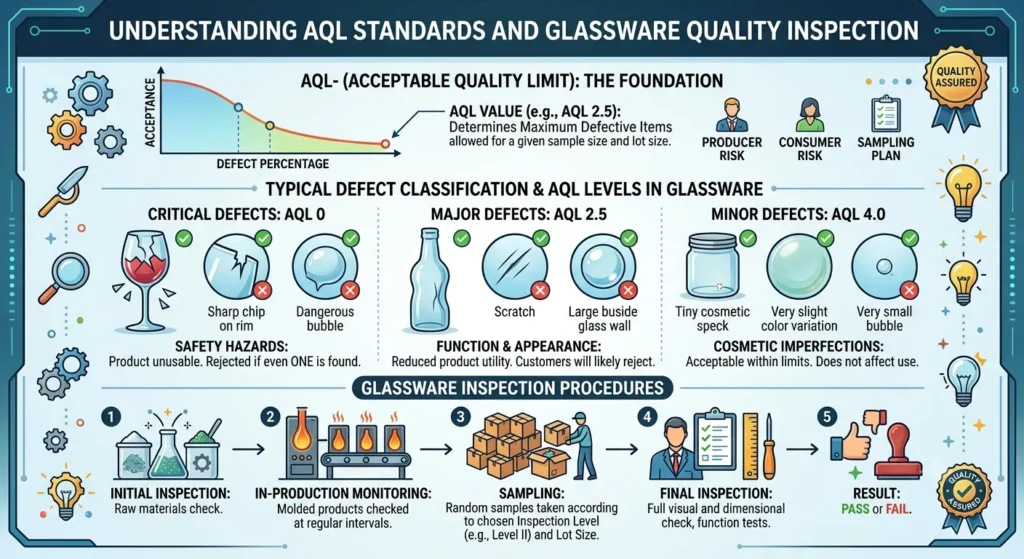
EasyLife Housewares Inspection Procedures Throughout Production
A complete quality control system requires inspections at different stages of the manufacturing process. Instead of relying only on final inspection, quality checks are performed throughout production to identify and control potential issues early.
Initial Inspection Upon Factory Arrival
Products undergo initial inspections when they arrive at the factory. This inspection verifies that incoming products meet the required specifications and quality expectations before moving into further production or packaging processes.
Early inspection helps identify possible issues and prevents unsuitable products from continuing through later stages.
Quality Checks During Packaging
During packaging, inspections are conducted at three key stages:
Beginning of Packaging
- Confirm product condition and packaging requirements before production starts.
- Verify that packing methods meet the specified standards.
Middle of Packaging
- Conduct ongoing checks to ensure quality remains consistent during the packaging process.
- Monitor for any issues that may occur during mass packing.
End of Packaging
- Perform final packaging-stage checks to confirm that finished products and cartons meet requirements before shipment.
This inspection approach helps maintain consistency throughout the packaging process.
Random Inspection Before Shipment
Before leaving the factory, random inspections are performed on bulk shipments. Samples are selected from the production lot and evaluated according to agreed quality criteria.
The inspection process checks:
- Product appearance
- Product specifications
- Packaging condition
- Defect classification and acceptance limits
If inspection results exceed the allowed defect limits, corrective actions such as sorting, replacement, or re-inspection may be required before shipment approval.
Why AQL Standards Matter
A clear AQL requirement helps create a consistent understanding between buyers and suppliers. By defining inspection standards, defect categories, and acceptance criteria before production begins, both parties can evaluate product quality using the same expectations.
A professional quality agreement may specify:
- Applicable inspection standards
- Sampling methods
- Critical, major, and minor defect limits
- Inspection conditions such as lighting, viewing distance, and evaluation criteria
Quality Inspection Practices in Manufacturing
A structured inspection process helps ensure that products meet agreed quality requirements throughout production. By combining incoming inspections, in-process quality checks, and final shipment inspections, manufacturers can identify potential issues earlier and maintain consistent product standards.
At Easylife Housewares, quality inspections are integrated throughout the production process. Products are inspected upon arrival at the factory, quality checks are conducted at the beginning, middle, and end of packaging, and random inspections are carried out on bulk shipments before products leave the factory. These procedures support consistent quality control and ensure that products are evaluated according to established requirements before delivery.
Final Thoughts: The Key to Consistent Glass Quality
In the world of glassware sourcing, clarity is quality. Understanding that AQL 2.5/4.0 is a statistical safeguard—rather than an acceptance of flawed products—empowers buyers to make smarter sourcing decisions. With structured quality controls active throughout factory arrival, packaging, and pre-shipment, you can rest assured that your glass products meet rigorous safety and cosmetic standards. Are you planning a glassware, bottle, or container production? Reach out to the team at EasyLife Housewares today to learn more about how our integrated inspection procedures can secure your supply chain and deliver the quality your customers expect.