
Have you ever noticed a tiny bubble frozen inside your glass measuring cup, a slight waviness to your baking dish, or a subtle wobble when you set a drinking glass on the kitchen counter? Sometimes, even the moment you put the glass lunchbox from the fridge into the microwave, it can shatter.
When shopping for bargain-bin kitchenware, it’s easy to dismiss these little quirks as “character” or harmless cosmetic flaws. After all, if it holds water, it works, right?
Unfortunately, in the world of glassware manufacturing, these minor imperfections are often warning signs of deeper structural failure. Cheap manufacturing processes cut corners on quality control, leading to defects that compromise both the beauty and—more importantly—the safety of your kitchen tools.
Here is how you can inspect your glassware like a pro and spot the most common factory defects before they turn into a dangerous mess on your countertop.

The Difference Between Aesthetic and Structural Flaws
Before diving in, it’s important to understand that not all defects are created equal:
Cosmetic Flaws: These are superficial defects, like a faint external scuff or a tiny, harmless surface scratch. They affect how the glass looks, but not how it performs.
Structural Flaws: These are hidden, systemic weaknesses inside the glass itself. They compromise the integrity of the item, making it highly susceptible to cracking, chipping, or violently shattering under ordinary thermal stress or minor impacts.
5 Common Glassware Defects & How to Spot Them
1. Air Bubbles
How to Spot It: Hold the glassware up to a bright light source or a window. Inspect the walls closely for tiny round or elongated pockets of trapped air.
The Danger: A bubble isn’t just an aesthetic flaw; it is literally a pocket of empty space where solid glass should be. This drastically thins out the surrounding glass wall, creating a severe structural stress point. If you pour boiling water into the vessel or bump it against the faucet, the glass is highly likely to crack or fracture right at the site of that bubble.
2. “Wavy” Glass or Optical Distortion
How to Spot It: Hold the glass at arm’s length and look through it at a straight line, like a window frame or the edge of a door. Slowly move the glass back and forth. If the straight line looks warped, bent, or like it’s underwater, the glass has severe optical distortion.
The Danger: This waviness indicates that the glass thickness is highly uneven. When uneven glass is exposed to rapid temperature changes (like going into a microwave or dishwasher), the thin areas expand faster than the thick areas. This uneven expansion causes intense internal stress, often resulting in sudden thermal shock shattering.
3. Unstable Bases or “Rockers”
How to Spot It: Place the glassware on a completely flat, hard surface (like a quartz or granite countertop). Gently press down on different sides of the rim. If the vessel rocks, wobbles, or spins easily, the base is uneven.
The Danger: Beyond the obvious risk of tipping over and spilling hot liquids, an uneven base means the weight of the glass isn’t distributed properly. When you set it down forcefully on a hard surface or an oven grate, the entire weight of the dish concentrates on a single, tiny pressure point, which can cause the base to spontaneously crack over time.
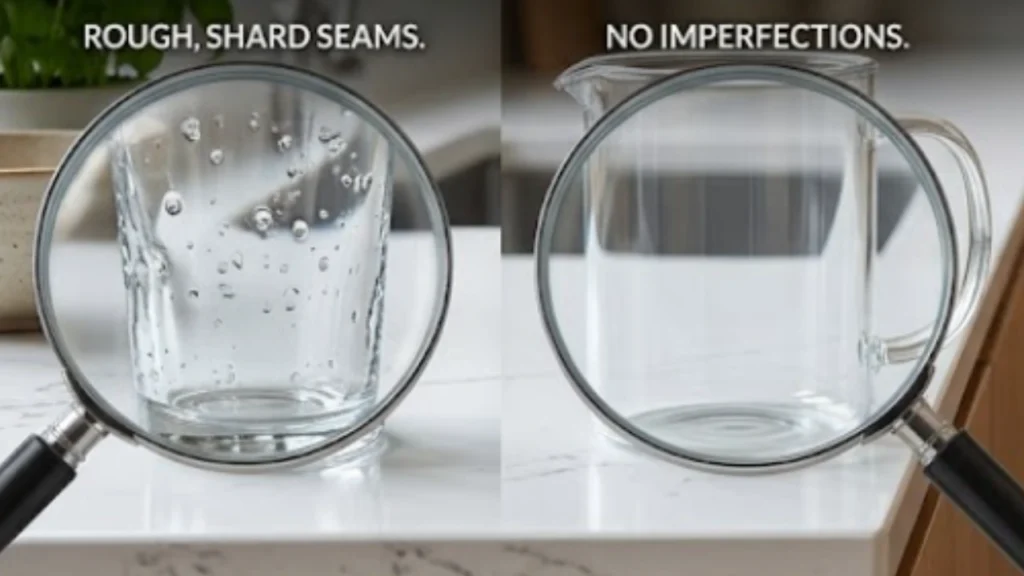
4. Sharp Mold Lines and Unfinished Seams
How to Spot It: Run your fingers carefully along the sides, handles, and rims where the factory mold pieces originally met. Cheap glass often features raised, sharp, or jagged seams that feel rough to the touch.
The Danger: High-quality manufacturers meticulously grind and polish away mold seams. Cheap brands skip this step to save time and money. These rough, raised seams are incredibly fragile and are usually the first places to chip during washing, leaving behind razor-sharp edges.
5. Internal Stress Lines
How to Spot It: Use the “Tink” Test. Hold the glass gently by its base and tap the rim lightly with a metal ring or a spoon. High-quality, structurally sound glass will produce a clear, ringing, bell-like tone that sustains for a second or two. Defective, cheap glass with high internal stress will produce a short, flat, dull “thud.”
The Danger: When cheap factories rush production, they cool the glass down too quickly to clear the conveyor belts for the next batch. This skips a crucial stabilization process called annealing. The result is massive internal tension trapped within the atomic structure of the glass. It becomes a ticking time bomb waiting for a minor bump or temperature change to spontaneously burst.
The EasyLife Housewares Guarantee: Our Zero-Defect Standard
At EasyLife Housewares, we believe that you shouldn’t have to gamble with your safety just to get a beautiful piece of glassware.
We implement a rigorous, multi-stage quality control line to ensure that every single piece of borosilicate glass leaving our facility is free from dangerous structural defects. Our glass is undergoing a precise, prolonged annealing process—cooling down at a strictly controlled, slow rate to completely eliminate internal atomic stress.
We have a comprehensive quality inspection department to ensure that all steps of the production process are successfully completed before the products are shipped, ranging from the actual products themselves to the packaging processes.
If a piece has a structural bubble, an uneven base, or optical distortion, it never makes it to our shelves. We do the worrying so you don’t have to.
Recommended products

Conclusion
Cheap glassware might save you a few dollars at the register, but it frequently costs more in the long run when it chips in the sink or shatters in the oven. Inspecting your kitchenware takes less than 60 seconds, but investing in premium, flawlessly engineered glass saves you years of headaches.
Don’t risk unexpected kitchen disasters. Upgrade your kitchen with flawless, rigorously tested durability.