In the high-stakes world of food manufacturing and bulk wholesaling, “freshness” is a measurable metric of inventory integrity and regulatory compliance. Choosing the wrong storage solution doesn’t just result in stale product; it results in rejected shipments, failed audits, and eroded profit margins.
Whether you are auditing a new supplier or verifying your own inventory, knowing how to identify a true hermetic seal is critical. Here is how to distinguish a professional-grade container from a standard kitchen jar.
What is an Airtight Container?
In a professional wholesale or industrial context, the answer to “What is an airtight container?” goes far beyond a simple lid and a box. It is a technical specification for a hermetically sealed vessel engineered to maintain a controlled internal environment.
1. The Technical Definition
An airtight container is a storage unit designed to be impermeable to gases. Unlike “leak-proof” containers (which only prevent liquids from escaping), a true airtight container prevents the exchange of air, oxygen, and water vapor between the inside of the container and the external atmosphere.
2. The Mechanics of the Seal
For a container to be classified as truly airtight in a commercial setting, it must feature:
- Mechanical Compression: A locking mechanism (latches, clamps, or threaded rims) that applies even pressure across the entire seal.
- Gasket Technology: A high-performance interface—usually made of Food-Grade Silicone, EPDM, or Viton—that deforms under pressure to fill microscopic gaps between the lid and the body.
- Non-Porous Walls: The body must be made of materials with near-zero gas permeability, such as 316 Stainless Steel, specialized HDPE, or thick-walled Borosilicate Glass.
- Vacuum Capability (Optional but Optimal): The highest tier of airtight storage allows for the extraction of air, creating a negative-pressure environment that further stabilizes the product.
3. The Functional Purpose
In industries like food wholesaling, pharmaceuticals, or specialty chemicals, an airtight container serves as a biosecurity and stability barrier:
- Oxidation Prevention: It stops oxygen from reacting with sensitive compounds (preventing rancidity in oils or potency loss in active ingredients).
- Moisture Control: It prevents hygroscopic materials (like sugar, salt, or chemical powders) from absorbing ambient humidity and clumping or degrading.
- Aroma Preservation: It traps volatile organic compounds (VOCs) inside, ensuring that high-value goods like coffee, spices, or botanicals retain their market value.
- Contamination Shield: it acts as a physical wall against airborne dust, microbes, and common warehouse pests (like pantry moths or weevils).
Why Does It Matter to Choose an Airtight Container?
The transition from “sealed” to “truly airtight” impacts two critical areas of a business operation:
The Food Safety Perspective: Risk Mitigation
- Microbial Inhibition: Most food-borne pathogens and aerobic molds require oxygen. An airtight seal creates a modified atmosphere that starves these organisms.
- Contamination Barrier: In a wholesale environment, airborne dust, chemical vapors, and allergens are constant threats. A “closed-loop” container ensures the product remains pure from the moment it is packaged until it reaches the end customer.
- Audit Readiness: Using airtight containers is a proactive defense against pests like weevils or pantry moths. This is essential for passing SQF, BRC, or FDA inspections.
The Wholesale Perspective: Protecting the Bottom Line
- Moisture Migration Control: Wholesalers moving goods across different climate zones face the risk of “clumping” in powders or “softening” in crisp goods. Airtight seals prevent humidity from ruining bulk inventory.
- Aroma & Potency Retention: For high-value goods like spices, coffee, or botanicals, the value lies in the volatile oils. If the container isn’t airtight, the product loses its potency—and its market value—every day it sits in the warehouse.
- Reduction of “Shrinkage”: In bulk operations, a 2-3% loss due to spoilage can equal tens of thousands of dollars. Airtight storage turns that waste back into profit.
How to Know If a Container is Airtight: 7 Clear Signs That a Container is Airtight
Before you run a physical test, you can identify high-quality engineering through these seven professional indicators:
- Uniform Gasket Compression: Look for a high-quality silicone or EPDM gasket. When the lid is closed, the gasket should be visibly compressed evenly around the entire rim.
- The “Hiss” Sound: Upon opening a high-quality container, you should hear a distinct “whoosh” or “hiss,” indicating that the internal pressure was different from the atmospheric pressure.
- Resistance When Closing: A truly airtight seal requires a small amount of physical force to engage the locking mechanism, ensuring the gasket is fully seated.
- Integrated Locking Latches: Professional containers rarely rely on friction alone. They use mechanical latches (2-way or 4-way) to maintain constant downward pressure.
- No Lingering Odors: If you can smell the contents (like coffee or spices) while the lid is closed, the container is leaking volatile organic compounds (VOCs) and is not airtight.
- Heavy-Duty Material Gauge: True airtightness requires rigid walls (like Borosilicate glass or thick-walled 316 Stainless Steel) that won’t warp or flex, which would break the seal.
- Vacuum Indicator: Many professional-grade containers feature a “pop-down” indicator or a valve that shows a vacuum has been successfully pulled and maintained.
5 Professional DIY Methods to Test Airtight Integrity
1. The Underwater “Bubble” Test (The Gold Standard)
This is the most definitive way to find a leak.
- The Method: Seal the empty container and submerge it completely in a transparent tank of water.
- What to look for: Watch for a steady stream of bubbles escaping from the rim or the valve. If bubbles appear, the seal is compromised.
- Pro Tip: After 30 seconds, remove the container, dry the outside perfectly, and open it. If there is even a drop of moisture inside, the container is not moisture-proof.
2. The “Flashlight” Light-Leak Test
This method is excellent for checking the uniformity of the gasket (the silicone ring).

- The Method: In a dark room, place a high-powered, small LED flashlight inside the container and seal the lid.
- What to look for: Rotate the container and look for any light escaping through the seal.
- The Science: If light can get out, air (which is much smaller than light waves in practical terms) can certainly get in. A perfect seal should show zero light leakage.
3. The “Paper Strip” Compression Test
This tests the mechanical “bite” of the locking latches.
- The Method: Place a thin strip of paper (like a receipt or a dollar bill) across the rim of the container, then close and lock the lid so the paper is trapped.
- What to look for: Try to pull the paper out.
- The Result: If the paper slides out easily, the gasket isn’t compressing enough. If the paper is stuck tight or tears when you pull it, the container has excellent mechanical tension. Repeat this on all four sides.
4. The Temperature-Induced Vacuum Test
This uses physics to prove the seal can hold a pressure differential.
- The Method: Pour a small amount of very hot (but not boiling) water into the container, swirl it to warm the air inside, pour the water out, and quickly seal the lid. Place the container in the refrigerator for 10 minutes.
- What to look for: As the air inside cools, it contracts, creating a vacuum.
- The Result: If the container is airtight, the lid should be significantly harder to open, or the “vacuum indicator” should be engaged. If it opens with zero resistance, the seal leaked during the cooling process.
5. The “Flour & Weight” Desiccant Test
This is a long-term test used to check for “Moisture Migration,” which is vital for wholesalers.
- The Method: Fill a container with a known weight (use a digital scale) of dry flour or salt. Seal it and place it in a high-humidity environment (like a bathroom or near a steamer) for 24–48 hours.
- What to look for: Weigh the container again.
- The Science: If the weight has increased by even a fraction of a gram, the container has absorbed ambient moisture from the air. A truly airtight container will maintain its exact weight regardless of external humidity.
Choose an Airtight Container Brand You Can Trust: Partnering with EasyLife Housewares
In the global supply chain, your storage solution is only as reliable as the manufacturer behind it. For B2B buyers, wholesalers, and food service distributors, EasyLife Housewares stands as a premier partner in professional-grade containment.
As a specialized kitchen glassware wholesaler with decades of industry expertise, we understand that “airtight” is a commitment to quality that your business depends on.
The EasyLife Advantage: Factory-Direct Excellence
We don’t just supply containers; we engineer them. By choosing EasyLife Housewares, your business benefits from a vertically integrated manufacturing process:
- In-House Manufacturing & Quality Control: Operating our own state-of-the-art factory allows us to maintain rigorous oversight on every seal, gasket, and glass rim that leaves our facility.
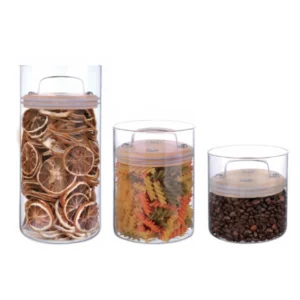
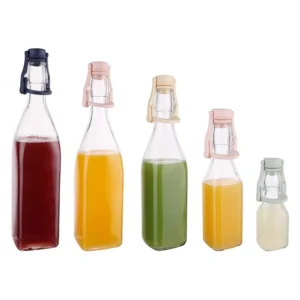
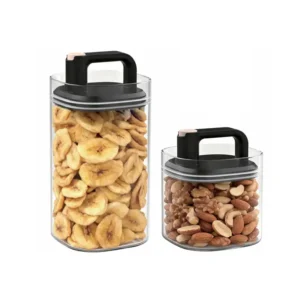
- Comprehensive Product Ecosystem: Our extensive product line covers every commercial need—from high-durability lunch boxes and canisters to specialized storage jars and bulk vacuum containers.
- Customization via ODM & OEM: We understand that different industries have unique requirements. We fully accept ODM&OEM projects, allowing you to bring proprietary storage solutions to market under your own brand.
- Dedicated Design Department: Our internal design team stays ahead of market trends and functional requirements, ensuring that our products offer the perfect balance of aesthetic appeal and industrial performance.
Recommended products
Scalable Solutions for Global Wholesalers
Whether you are looking to stock a retail line or need high-performance vessels for bulk food distribution, EasyLife Housewares provides the scalability and technical support necessary to protect your inventory and your brand reputation.
We support you to get free samples to confirm whether our high quality meets your business needs, and we have the experience to provide professional guidance and advice to our customers. Contact us for a turning point in your business!