In the global kitchenware market, “Safety” is the most expensive word a brand can own. As consumers become increasingly concerned about chemical leaching, the demand for lead-free glassware has skyrocketed. However, for B2B importers and brand owners, “lead-free” isn’t just a marketing claim—it’s a complex landscape of international certifications, lab tests, and shifting regulations.
If you are sourcing glassware for the US or European markets, failing to understand the difference between FDA and LFGB standards can lead to more than just bad reviews; it can result in costly customs seizures and legal liabilities.
Understanding Lead and Cadmium in Glassware
In traditional glass manufacturing, lead oxide was often added to increase the refractive index (sparkle) and make the glass softer for intricate cutting. Cadmium is typically found in the pigments used for bright reds, oranges, and yellows in decorative decals.
While these materials serve aesthetic purposes, they are “heavy metals” that do not bond permanently with the glass structure. Over time, or when exposed to heat and acidic liquids (like citrus juice or vinegar), these metals can migrate from the container into the food—a process known as leaching.
Is Lead (or Cadmium) Glass Safe?
For decorative crystal that is rarely used, the risk is low. However, for daily food storage, the consensus among global health authorities (like the WHO and FDA) is clear: There is no safe level of lead ingestion.
- Cumulative Toxicity: Lead stays in the body for years, affecting the nervous system.
- The Risk for Brands: Selling glassware that leaches lead can result in massive product recalls and high-figure lawsuits.
- The Assembly Factor: Even if the glass bottle is safe, if the lid or the decorative logo contains cadmium, the entire product is deemed “Unsafe” by LFGB standards.
What Does “Lead-Free” Actually Mean in Glass Manufacturing?
Most high-quality modern glassware, especially high-borosilicate glassware, is naturally lead-free because its chemical composition relies on boron trioxide rather than lead oxide to achieve clarity and heat resistance.
However, lead and cadmium can still enter the supply chain through:
- Low-quality raw materials: Contaminated silica sand.
- Decorative Elements: Enamels, decals, or rim coatings that contain heavy metals for color brilliance.
- Cross-contamination: Factories that process leaded crystal in the same facility as food-grade glass.
The Gold Standards: FDA vs. LFGB
When you evaluate a supplier like EasyLife Housewares, you will likely see two major certifications. Here is how they differ:
1. FDA (United States)
The U.S. Food and Drug Administration (FDA) regulates glassware under the Federal Food, Drug, and Cosmetic Act.
- The Focus: The FDA primarily checks for “extractable” lead and cadmium—how much of the metal actually leaches into food or drink.
- The Threshold: FDA standards are strict, but they allow for microscopic traces as long as they fall below specific parts-per-million (ppm) limits.
2. LFGB (Germany & European Union)
The Lebensmittel- und Futtermittelgesetzbuch (LFGB) is the German “Food and Feed Code.” It is widely considered the strictest standard in the world, surpassing even basic EU requirements.
- The Focus: While the FDA focuses on leaching, LFGB often tests the material composition more holistically.
- The Reputation: If a product passes LFGB, it is guaranteed to pass FDA and almost any other global standard. For premium brands, LFGB is the ultimate “Seal of Approval.”
Comparing Lead-Free Glassware Standards
| Feature | FDA Compliance (USA) | LFGB Compliance (Germany/EU) |
| Primary Focus | Leachable lead and cadmium | Total material safety and sensory testing |
| Global Standing | Standard for North America | “Gold Standard” for Global markets |
| Lead Free Status | Required for all food contact | Strictly enforced zero-migration levels |
| Consumer Trust | High | Highest |
Beyond the Basics: California Prop 65
For brands selling in the United States, meeting FDA standards might not be enough. California Proposition 65 requires a specific warning label on products if they contain even trace amounts of chemicals known to cause cancer or reproductive harm—including lead.
At EasyLife Housewares, we ensure our high-borosilicate production lines are strictly monitored to meet Prop 65 requirements, allowing our clients to sell in the California market without the need for frightening warning labels.
Tips to Identify Lead Free Glassware
As an experienced assembly partner, EasyLife Housewares uses professional laboratory equipment to verify purity. However, procurement managers can use these three “Field Tests” to spot potential risks:
- The Sound Test (The “Ring”): When tapped gently with a metal spoon, lead free glass (especially borosilicate) produces a high-pitched, short “clink.” Leaded crystal produces a long, drawn-out musical “ring.”
- The Weight Factor: Lead is heavy. If a small jar feels surprisingly heavy for its size, it likely contains lead oxide. High-borosilicate lead free glass is prized for being lightweight yet incredibly strong.
- The Light Refraction: Hold the glass up to the light. Lead glass creates a “prism” effect (rainbow sparkles). Genuine food-grade lead free glass is ultra-clear but does not split the light into rainbows.
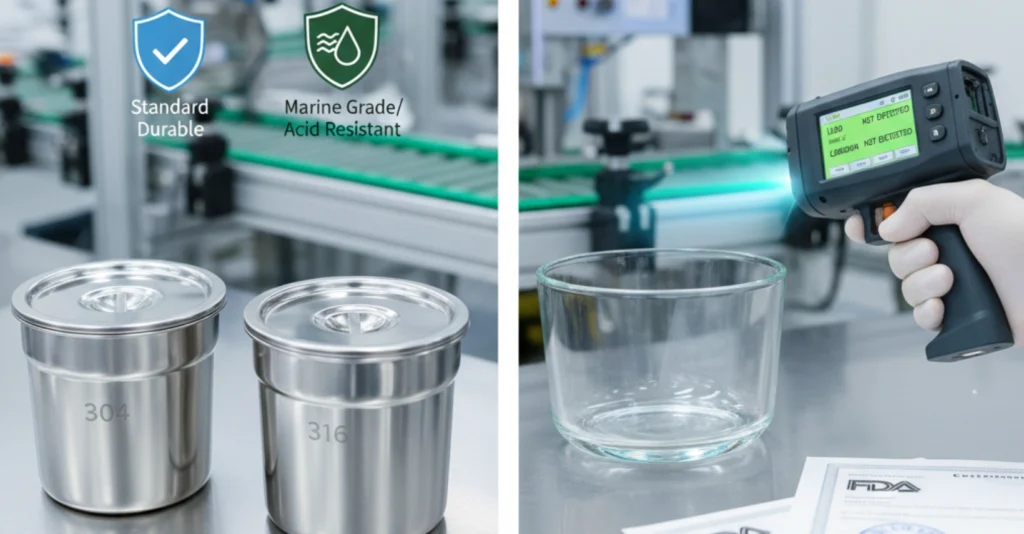
- Verification of Markings: Always look for the “Borosilicate 3.3” mark or laser-etched compliance codes. As an assembly hub, we ensure these markings are accurately applied only after material verification.
How EasyLife Housewares Guarantees Lead Free Glassware Wholesale
At EasyLife Housewares, we don’t just “put parts together”; we engineer storage solutions. With over 10 years of expertise in sourcing high-borosilicate lead-free glass and food-grade metals, our assembly facility is optimized for precision. Our specialized knowledge of deep-drawing metal processes and glass-to-metal fitment ensures that every surface meets the rigorous aesthetic and safety standards of the global market.
The EasyLife ‘Zero-Risk’ Protocol
Sourcing from multiple overseas factories can be a gamble. EasyLife Housewares operates as your on-the-ground QC hub. Every batch of our products undergoes a multi-stage inspection:
- The Quality Firewall: We have a strict incoming inspection process. We act as your secondary inspection tier. Every component—from the glass body to the smallest gasket—is verified for FDA & LFGB compliance before it is packed.
- Expert Assembly: We ensure a perfect fitment between diverse materials (Glass, Stainless Steel, Wood, and Silicone) for a 100% airtight performance.
- Consolidated Logistics: We manage the complexity of multiple sub-factories, providing you with a single, reliable point of contact for OEM/ODM development and global shipping.
Tailored OEM/ODM & Bespoke Assembly
We understand that your brand needs to stand out. EasyLife Housewares offers comprehensive assembly-based customization. Whether you require custom laser-engraved logos, unique powder-coated finishes on lids, or bespoke “bundle” packaging, our design team works directly with your procurement office to bridge the gap between ‘factory-standard’ and ‘brand-exclusive.’
Conclusion: Protect Your Brand with Certified Assembly
In the glassware industry, a “cheap” price often hides a “toxic” cost. Choosing a partner that understands the nuances of lead-free glass and adheres to FDA and LFGB standards across the entire supply chain is an investment in your brand’s longevity.
Whether you are launching a new line of storage jars or high-end kitchen sets, EasyLife Housewares provides the integration, transparency, and safety precision you need to lead the market.
Ready to secure your supply chain? Contact our compliance team at EasyLife Housewares today for our latest lead-free certification reports.