In the competitive world of kitchenware retail, every square inch of shelf space is a silent salesman. For wholesalers and retailers alike, the decision between stocking round or square glass jars isn’t just about “the look”—it is a complex calculation involving geometry, structural integrity, and logistical ROI.
Whether you are looking to stock premium glass or durable stainless steel food storage, understanding the science behind the shape is key to maximizing your margins. Here is the definitive guide to the “Square Jars vs Round Jars” debate.
Square Jars vs Round Jars: 12 Critical Factors
1. Structural Strength (The Arch Effect)
Round Jars: Mathematically, the cylinder is superior. It distributes stress evenly across the surface. In a vertical drop test, round glass jars are 20–30% more resistant to shattering than square counterparts.
Square Jars: The 90° angles are “stress concentrators.” During the cooling process (annealing), glass can settle unevenly at the corners, creating weak points that are prone to chipping.
2. Volumetric Shelf Efficiency
Square Jars: These are the undisputed winners. By eliminating the “interstitial gap” (the empty air between round objects), square jars utilize nearly 99% of available shelf depth.
Round Jars: Due to their geometry, round jars leave roughly 21.5% of the shelf as “dead air.” For a retailer with limited square footage, square jars represent a 21% increase in “stockable” volume.
3. Conveyor Automation & Handling
Round Jars: Because they are rotationally symmetrical, they don’t require “orientation.” They glide through automated filling lines at speeds of 300–600 units per minute.
Square Jars: These require specialized sensors to ensure they are “square” to the filling nozzle. This complexity typically slows production speeds to 60–70% of a round line’s capacity.
4. Branding & The “Billboard” Effect
Square Jars: Each jar offers four flat “billboards.” This prevents label distortion and allows for high-density QR codes and small-print nutritional data to remain perfectly scannable.
Round Jars: The curve causes “text wrap.” Only about 40% of the label is visible from a direct front-on view, often requiring the customer to pick up the jar to read the brand name.
5. Vertical Load & Stacking Integrity
Round Jars: A cylinder distributes weight directly down its walls. In a warehouse, round jars can be stacked 3–4 pallets high with minimal risk of the bottom layer crushing.
Square Jars: The flat sides can “bow” under extreme vertical pressure. For wholesalers, this means square jars require higher-quality corrugated dividers to provide the structural support the glass lacks.
6. Ergonomics: Human Grip Science
Round Jars: The human hand is naturally evolved to grip cylindrical objects. A diameter of 6.5cm to 8.5cm is considered the ergonomic “sweet spot” for kitchen tasks.
Square Jars: While less “natural,” the corners provide a pivot point. For wet or greasy hands (common in kitchens), the corners of a square jar offer more mechanical leverage than a smooth round surface.
7. Manufacturing & Material Costs
Round Jars: A sphere/cylinder is the most material-efficient shape. To hold $1000\text{ml}$, a square jar requires approximately 12% more glass to maintain wall thickness. This makes round jars the more “eco-friendly” and cost-effective production choice.
8. Aesthetics: Organizational Psychology
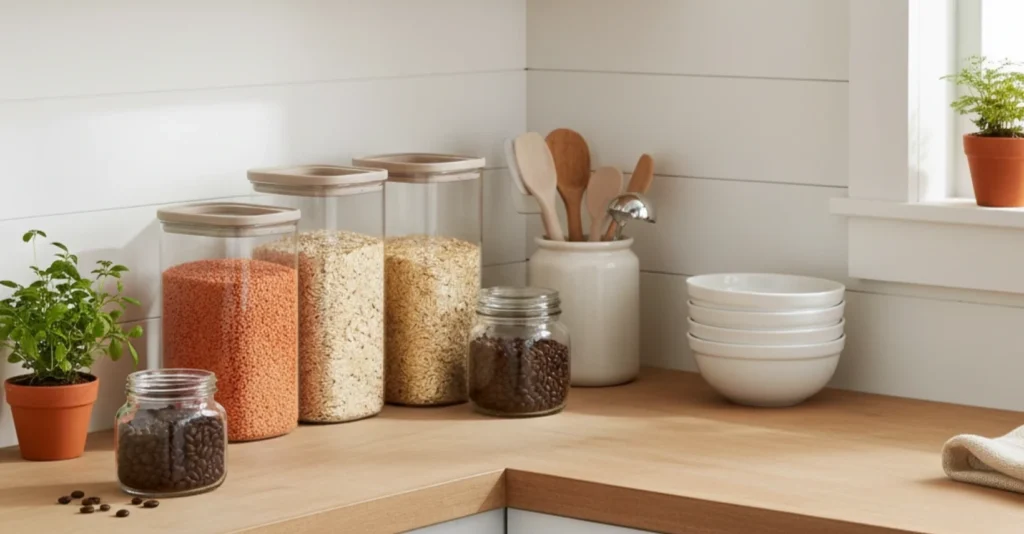
Square Jars: These appeal to the “Organization” demographic. They create a seamless “tiled” look that maximizes the Color Blocking effect—where the product colors (lentils, pasta, spices) become the primary visual draw.
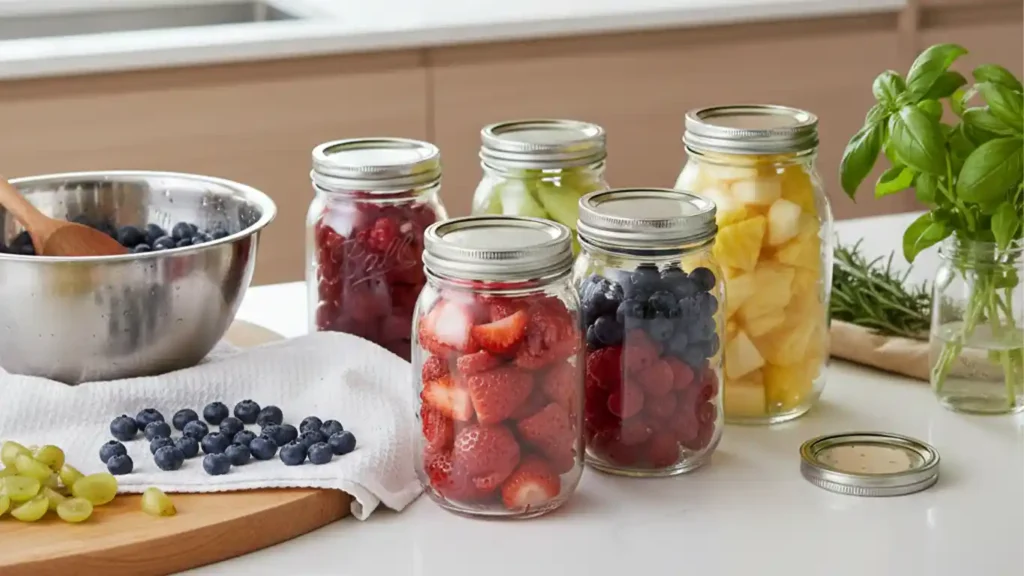
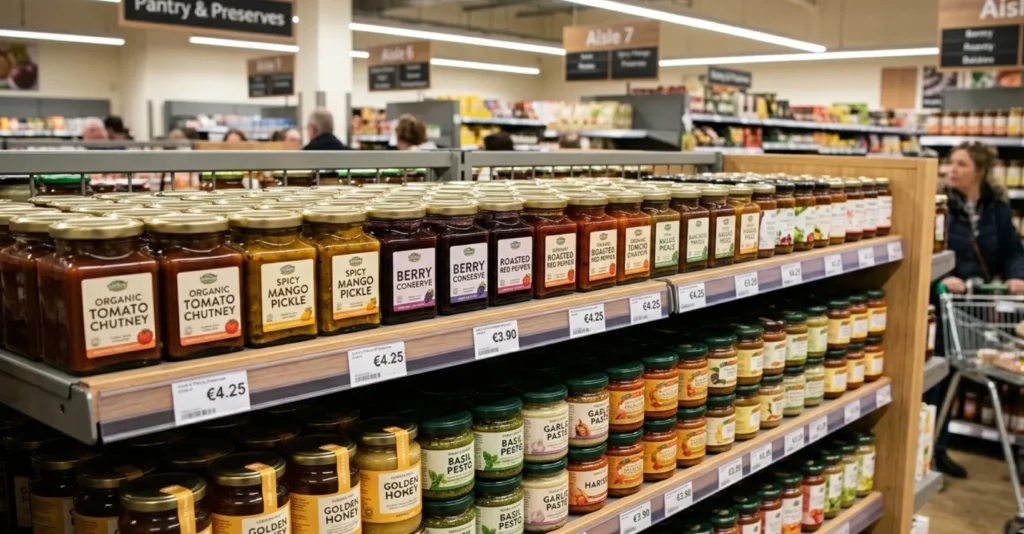
Round Jars: These evoke “Artisanal” feelings. They are associated with traditional canning, farmers’ markets, and premium preserves.
9. Simplicity of Use (The Scoop Test)
Round Jars: No “dead zones.” A spoon can reach 100% of the contents.
Square Jars: Up to 3–5% of viscous products (honey, sauces) can get trapped in the bottom corners. For dry goods like flour, this is less of a factor, but it makes cleaning square jars slightly more labor-intensive.
10. Export & Logistic Density
The Efficiency Gap: When you pack round jars into a square shipping carton, you are paying to ship 21.5% “dead air”—the empty gaps between the circles.
The Export Edge: For international shipping, square jars are the undisputed winner. They pack tightly like bricks, allowing you to fit roughly 20% more product into a 40ft shipping container. This drastically lowers the “freight cost per unit,” allowing wholesalers to pass those savings on to the retailer.
11. Thermal Shock Resistance
Round Jars: Because the glass expands and contracts uniformly when heated (e.g., in a dishwasher or for hot-fill preserves), round jars handle temperature changes better.
Square Jars: The corners expand at different rates than the flat sides, making them slightly more susceptible to “thermal stress cracks.”
12. Secondary Market Use (Sustainability)
Round Jars: Consumers are more likely to reuse round jars for “drinking glasses” or DIY canning.
Square Jars: Consumers prefer reusing square jars for “systematized storage” (e.g., a matching set of spice jars). Square jars are the leaders in the “Refill Shop” movement.
Compare Square Jars vs Round Jars
| Factor | Round Jars | Square Jars | Winner |
| Space Utilization | Low (78.5%) | Maximum (99%) | Square |
| Structural Durability | High | Moderate | Round |
| Shipping Efficiency | Poor (Ships “air”) | Excellent (Dense) | Square |
| Labeling / Branding | Curved | Flat (4-Sided) | Square |
| Ease of Cleaning | Total (No corners) | Harder (Corner residue) | Round |
| Cost to Produce | Lower (Material-lite) | Higher (Complex) | Round |
| Market Trend | Classic / Artisanal | Modern / Organized | Tie |
Glass vs Stainless Steel: Material Synergy
While the shape of the container dictates shelf efficiency, the material dictates the application. EasyLife Housewares, as a wholesaler offering both glass and stainless steel, it is vital to understand how these materials interact with round and square geometries.
The Visibility Factor
- Glass (Round/Square): Glass is the ultimate medium for “Visual Marketing.” Whether square or round, glass allows the product’s natural colors—like the vibrant orange of lentils or the deep green of specialty tea—to act as the primary branding.
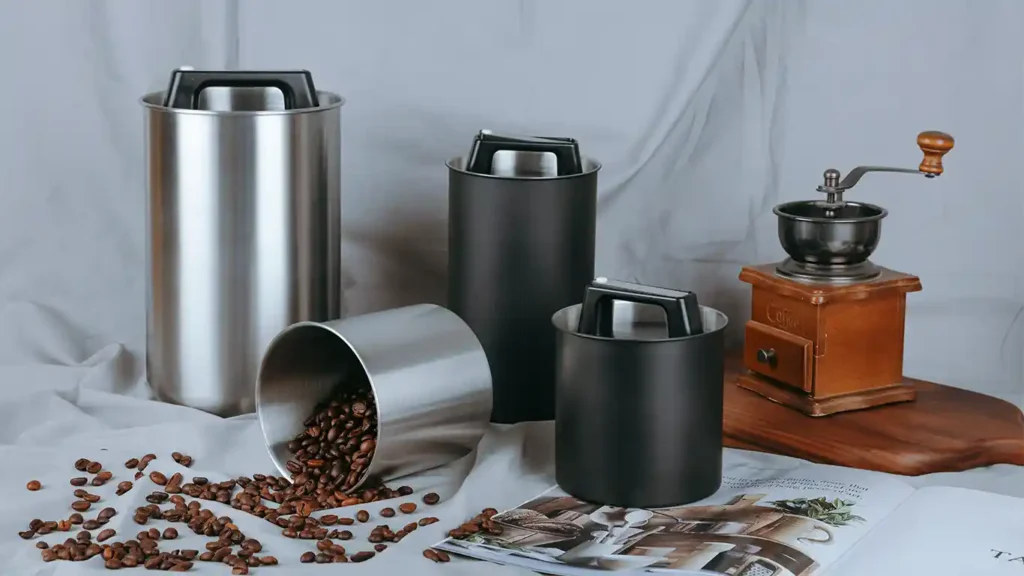
- Stainless Steel: Being opaque, stainless steel relies heavily on its shape and labeling for appeal. Square stainless steel jars are currently trending in professional-grade “chef’s kitchens” because they look industrial and allow for easy magnetic labeling on their flat sides.
Durability and “Corner Fatigue.”
- The Glass Constraint: As noted in our geometry analysis, square glass is more prone to chipping at the corners.
- The Stainless Steel Solution: Stainless steel eliminates the “corner weakness” of square shapes. A square stainless steel jar offers 100% shelf efficiency without the fragility of glass. This makes it the superior choice for high-traffic environments or commercial kitchens where jars are moved frequently.
Thermal and Airtight Performance
- Glass: Best for “hot-fill” products or items requiring a vacuum seal (like preserves). The round glass jar is the undisputed leader here due to its ability to handle the pressure of heat expansion.
- Stainless Steel: Excellent for light-sensitive goods (coffee, spices, oils). Because stainless steel is lighter than glass, square stainless steel canisters are significantly easier to stack vertically in high-volume retail displays without exceeding the shelf’s weight limit.
Which Should You Stock?
Choosing between round and square jars—and between glass and stainless steel—is not a matter of “which is better,” but “which fits the consumer’s lifestyle.”
The “Quick-Decision” Guide for Retailers:
Stock Square Glass Jars if
Your target demographic is the “Home Organizer” or the “Aesthetic Minimalist.” These are perfect for dry-good pantry sets where space-saving and “Pinterest-perfect” alignment are the top priorities.
Stock Round Glass Jars if
You are selling to traditionalists, artisanal food crafters, or budget-conscious shoppers. Round jars offer the best “value-per-unit” due to lower manufacturing costs and higher break-resistance.
Stock Square Stainless Steel if
You are targeting the “Professional Chef” or “Industrial Decor” market. These offer the maximum space efficiency of the square shape with the indestructible nature of metal.
Conclusion
To maximize your retail ROI, we recommend a hybrid stock strategy. Use square containers to anchor your “Organization” sections and round jars to highlight “Artisanal” or budget-friendly lines. By offering both, you ensure that every inch of your retail space—and your customer’s cupboard—is utilized to its full potential.