A glass pitcher looks straightforward on a spec sheet, yet in real-world retail and hospitality operations it is one of the fastest categories to generate either repeat reorders or costly customer complaints. One model pours cleanly on a brunch table; another drips down the side, slides out of a loose lid, or misses the height clearance of a standard refrigerator door by a single centimeter.
While seasonal guides often treat glass pitchers strictly as summer drinkware, today’s buyers source them as year-round, multi-temperature vessels—serving hot loose-leaf tea and pour-over coffee in winter, iced tea, cold brew, and fruit infusions in warmer months, and daily filtered water in between.
This wholesale buying guide breaks down the technical and commercial decisions that matter most when sourcing glass pitchers—covering glass material standards, capacity and dimensional planning, lid engineering, channel-specific use cases, and EasyLife Houseware’s OEM/ODM customization and quality controls.
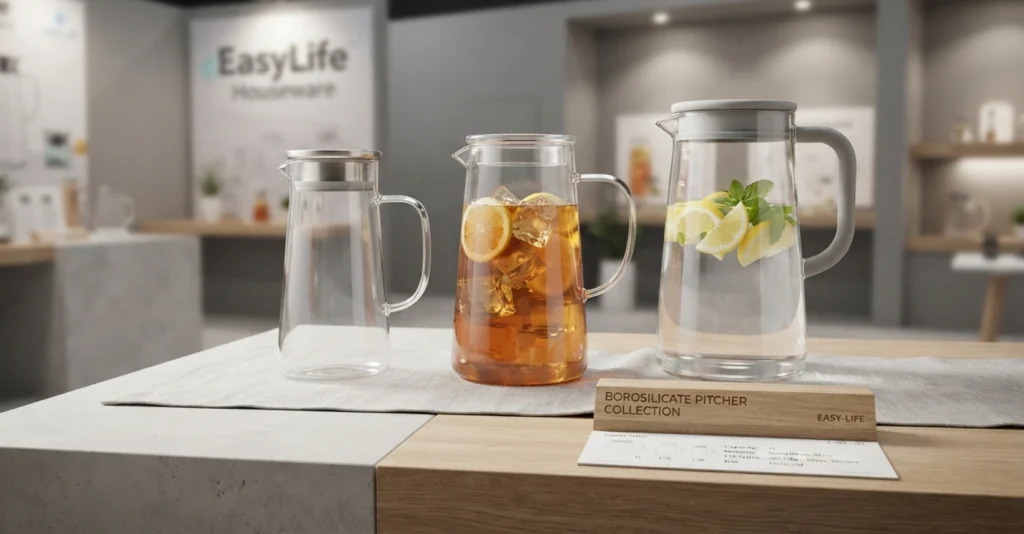
Material Foundation: Why High Borosilicate Glass Leads Modern Drinkware Lines
Before comparing capacities or closures, buyers should lock in the glass formulation. Across wholesale drinkware, the core choice is between high borosilicate glass and standard soda-lime glass:
- Thermal Shock Resistance: High borosilicate glass withstands rapid temperature shifts, allowing end users to brew hot tea or coffee directly in the vessel or move a pitcher from refrigerator storage to warm rinsing without stress cracking. Soda-lime glass is generally restricted to cold or ambient service.
- Weight-to-Strength Balance: Borosilicate pitchers achieve strong structural durability with thinner, lighter walls—reducing wrist fatigue for restaurant servers and home users when a 1.5L vessel is filled with water and ice.
- Optical Clarity & Flavor Neutrality: Lead-free borosilicate glass resists clouding over repeated dishwasher cycles and will not absorb citrus oils, coffee tannins, or herbal aromas.
At EasyLife Houseware, our drinkware catalog centers on food-grade high borosilicate glass engineered to meet strict international compliance standards (including FDA, LFGB, and California Prop 65 lead-free requirements), enabling retail and hospitality buyers to sell confidently across North American and European markets.
Capacity Tiers & Physical Footprint Planning
Experienced buyers never evaluate capacity in milliliters alone—they evaluate diameter, total height, and handle projection. A 1,500ml pitcher that cannot slide into a standard refrigerator door rack immediately limits household adoption, while an overly tall, narrow carafe on a crowded restaurant table risks tipping.
| Capacity Tier | Volume Range | Primary Channel Fit | Key Dimensional & Merchandising Checks |
| Compact & Tabletop | 750 ml – 1,100 ml | Cafes, single-table restaurant service, hotel rooms, small households, desk hydration | Check base stability, compact footprint (~9–15 cm width), and drip-free spout precision for frequent pouring. |
| Core Fridge-Door Standard | 1,500 ml | Retail housewares, e-commerce hero SKUs, family kitchens, cold brew | Verify max diameter and height (~24–25.5 cm) against standard fridge-door shelves; highest retail velocity. |
| High-Volume & Entertaining | 1,800 ml+ | Catering, buffets, brunch service, shared office/hospitality hydration stations | Confirm handle weld strength and ergonomic grip under full liquid + ice load; reduces staff refill frequency. |
Merchandising Tip for Retail Buyers: If your line targets e-commerce or mass retail, anchor your assortment around 1,500ml as your core SKU, then add a 750ml–1,100ml compact model for apartment dwellers, bedside/office hydration, and gift sets.
Lid Engineering & Closure Types: Where User Experience Is Won or Lost
In post-purchase reviews, lid fitment is the number-one point of failure on wholesale glass pitchers. A poorly sealed lid falls off mid-pour; a rigid lid without a proper silicone gasket rattles or leaks; and a single-opening lid struggles with fruit slices or loose-leaf tea.
Matching the lid mechanism to the beverage type prevents returns before they happen:
Stainless Steel Filter Lids (304 S/S + Food-Grade Silicone Gasket)
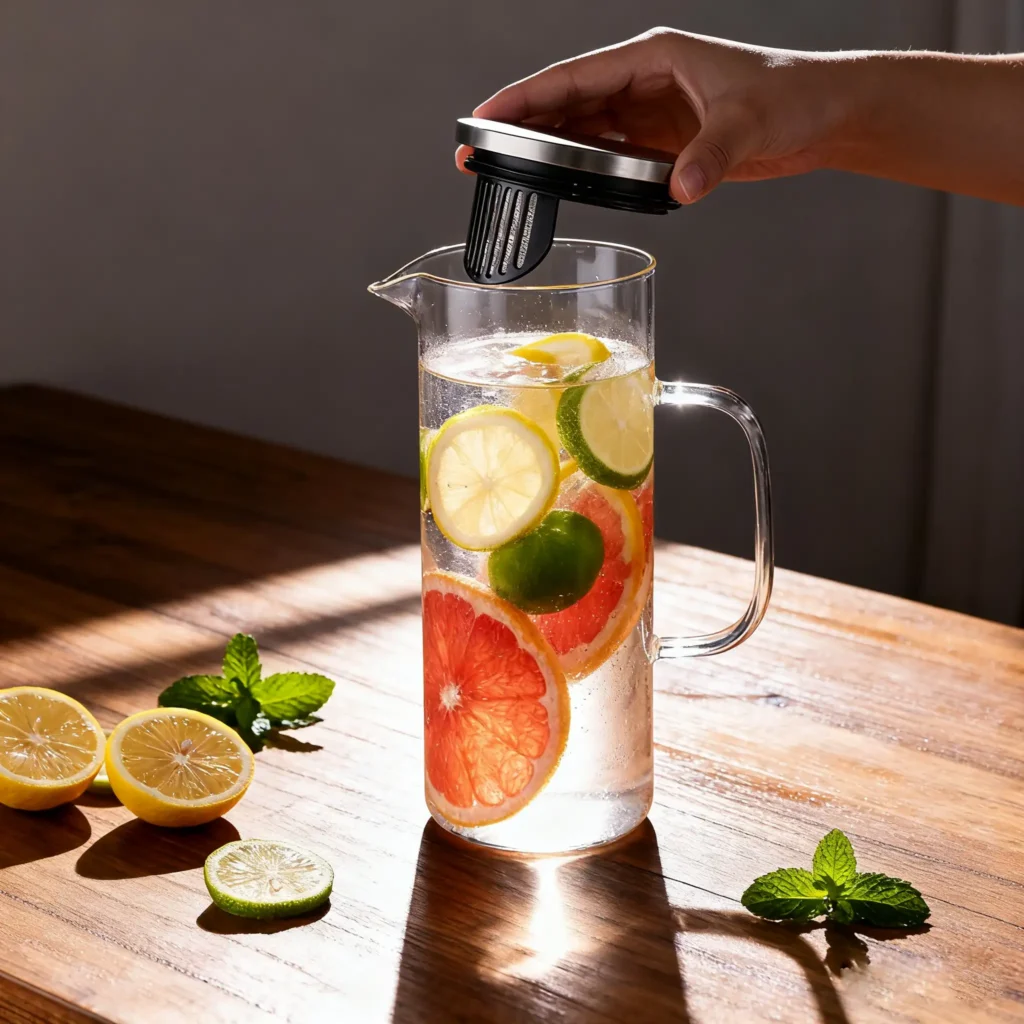
How It Works: Combines a brushed or mirror-finish stainless steel cap with a ribbed silicone ring that grips the glass neck securely during steep pours. Most designs incorporate dual pouring options—a wide opening for water or juice and a slotted/perforated filter edge to hold back ice cubes, mint leaves, citrus wedges, or loose tea.
Best For: All-purpose retail lines, fruit-infused water, iced tea, and sangria.
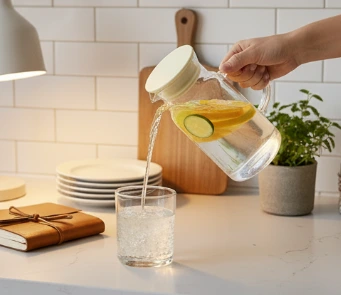
Food-Grade Silicone Lids
How It Works: Flexible, soft-touch silicone creates a snug, quiet seal that resists chipping and supports custom Pantone color matching for seasonal or private-label collections.
Best For: Family households, modern lifestyle retail brands, and everyday refrigerator storage.
All-Glass Storage Lids
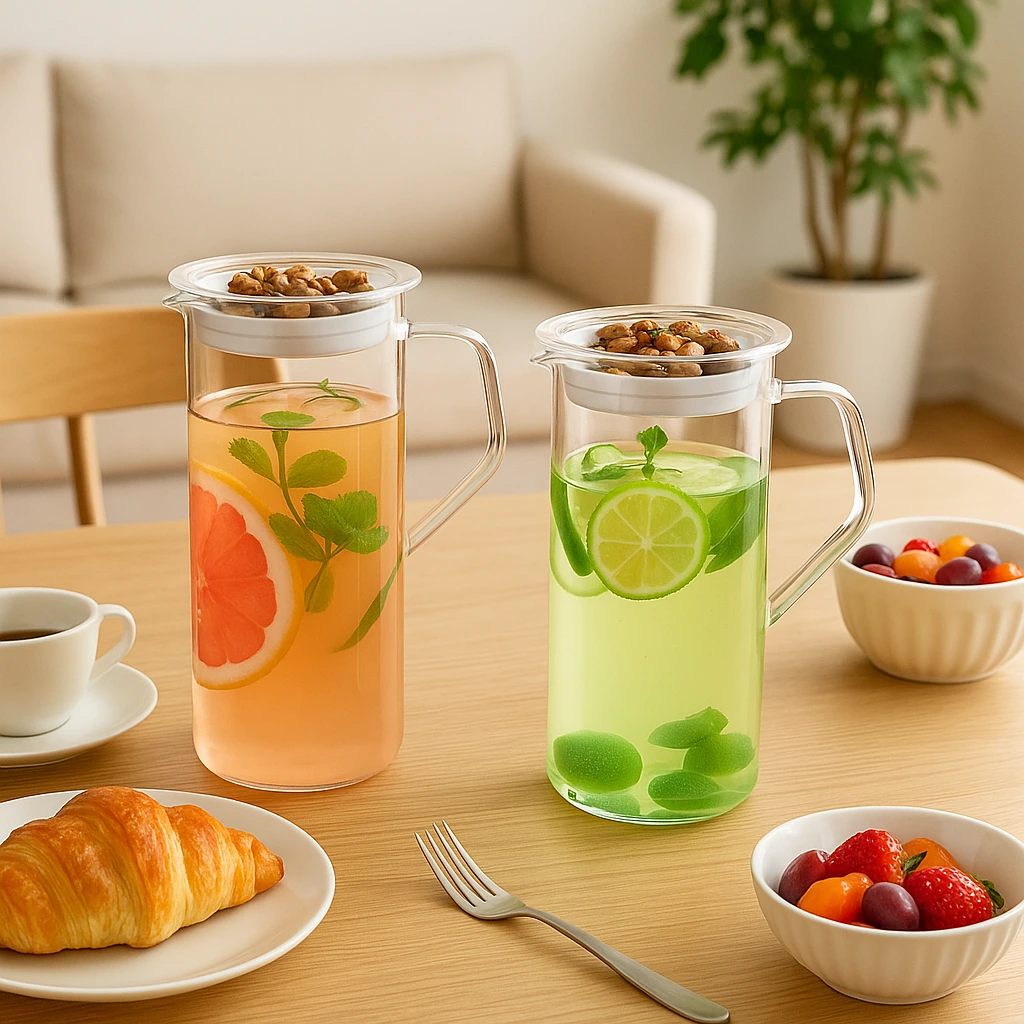
How It Works: A precision-fitted borosilicate glass cover with a silicone seal ring, eliminating plastic or metal contact above the beverage line.
Best For: Design-forward homeware boutiques, specialty tea brands, and minimalist table presentation.
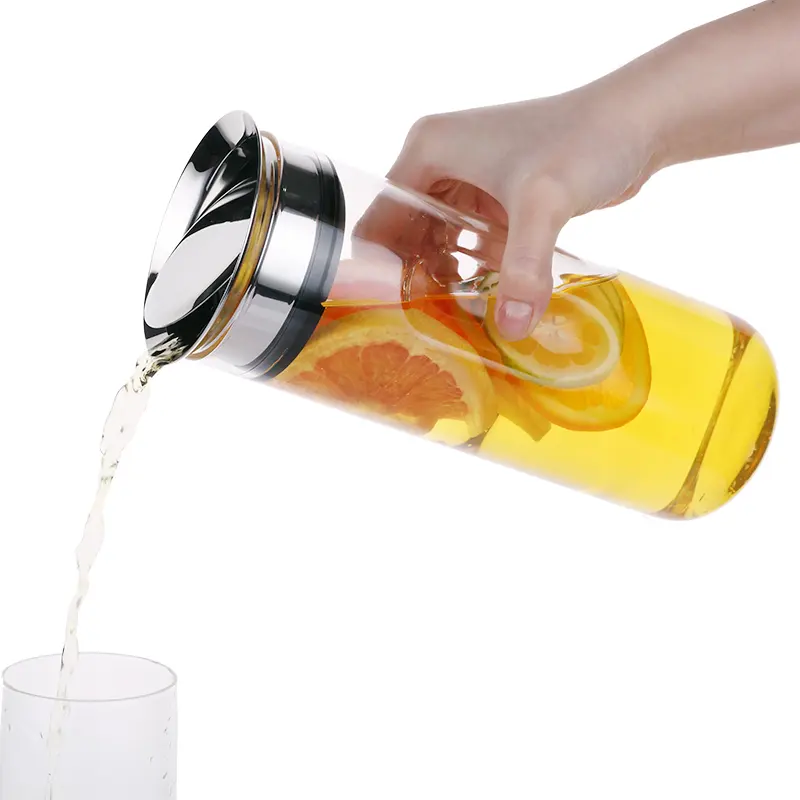
Gravity Automatic Opening & Closing Lids
How It Works: Counterbalanced lid mechanism tilts open automatically as the pitcher is angled to pour and closes flat when set upright—allowing one-handed service while blocking dust, insects, and refrigerator odors.
Best For: Outdoor dining, busy restaurant tables, breakfast buffets, and everyday family kitchens.
Airtight Swing-Top / Flip-Top Closures (Adjacent Bottle Assortments)
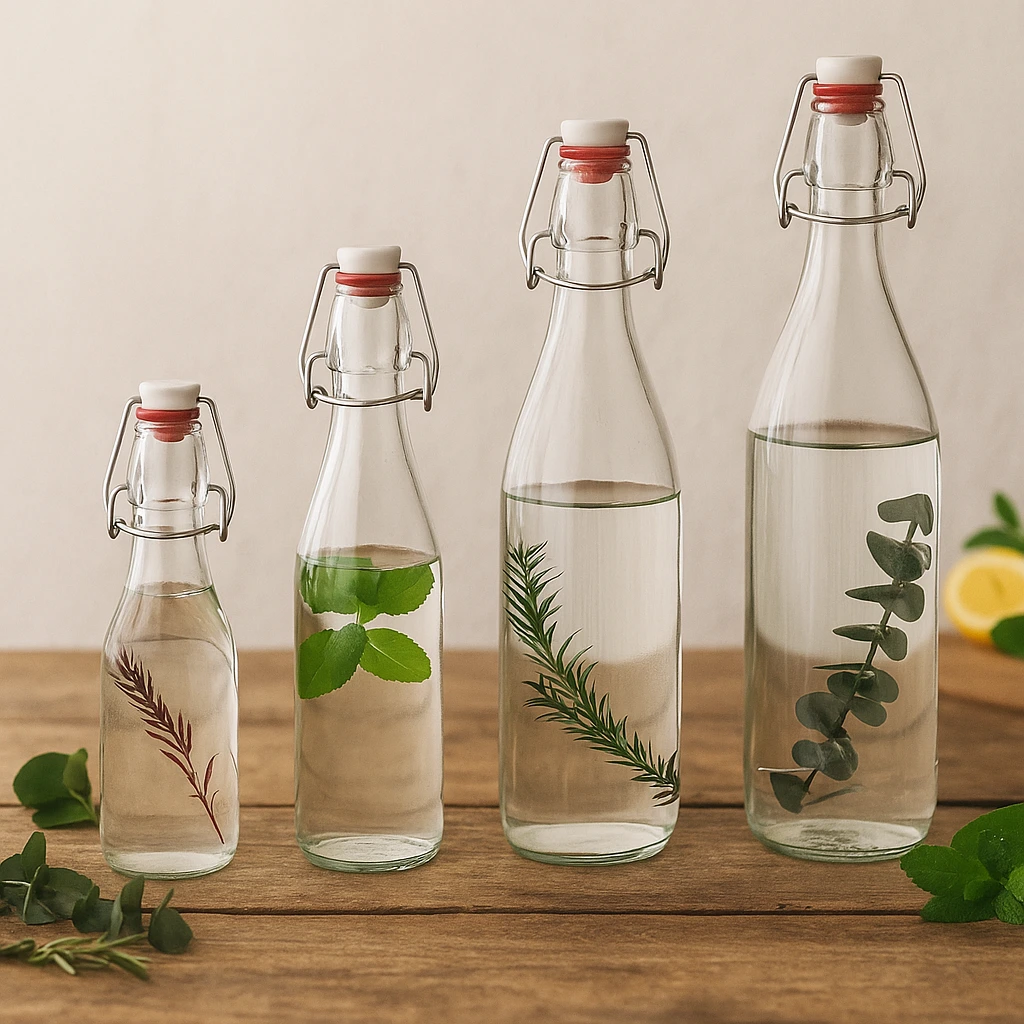
How It Works: Stainless steel wire-bail clamp with a leakproof stopper seal for full horizontal or vertical fridge storage and transport.
Best For: Cold-pressed juices, kombucha, infused syrups, and grab-and-go beverage programs.
Handle Ergonomics & Spout Geometry
Two structural details separate commercial-grade pitchers from fragile novelty glassware:
Handle Material & Attachment:
Integrated Borosilicate Glass Handles: Offer seamless visual transparency and dishwasher durability. Look for smooth, reinforced upper and lower weld joints with generous knuckle clearance.
Heat-Insulated PP Handles: Stay cool when serving hot tea or coffee and add grip security in fast-paced foodservice environments.
V-Shaped Anti-Drip Spouts & Wide Mouths:
A cleanly pulled V-spout cuts liquid flow sharply at the end of a pour, preventing drips onto linen tablecloths or retail countertops.
A wide-mouth opening lets end users add whole lemon slices or large ice cubes easily—and reach inside with a standard sponge for effortless cleaning.
Matching Pitchers to Commercial & Retail Use Cases: A Buyer’s Assortment Strategy
Instead of buying a single “all-purpose” pitcher and hoping it performs everywhere, experienced buyers build their assortment around where the pitcher will live, who will handle it, and what goes inside it. Different channels punish different design flaws:
1. Specialty Coffee Shops, Tea Rooms & Juice Bars
Operational Reality: High turnover, rapid shifts between hot brewing and iced service, and frequent exposure to loose leaves, citrus pulp, or coffee grounds.
What Buyers Should Prioritize:
- Thermal shock resistance so baristas can brew hot tea or pour-over concentrate directly into the vessel before chilling over ice.
- Integrated straining or dual-outlet filter lids to catch tea leaves, mint, or fruit seeds without requiring a separate bar strainer.
- Dedicated cold-brew extraction vessels (typically 1.2L–1.5L with fine mesh cores) to capitalize on high-margin slow-drip coffee programs or retail coffee-gear add-on sales.
What to Avoid: Narrow-neck carafes that trap fruit pulp or stain easily from black tea and coffee tannins.
2. Restaurants, Hotels & Catering (HoReCa)
Operational Reality: Staff carry full pitchers one-handed through crowded dining rooms, tables have limited surface area, and dishwashers run non-stop.
What Buyers Should Prioritize:
- Handle ergonomics and load balance: When filled with 1.5L of water and ice, a pitcher weighs roughly 2 kg (4.4 lbs). Look for generous knuckle clearance, reinforced upper-and-lower handle welds, and heat-insulated handle options if hot beverages are served.
- Drip-free spout geometry and self-closing lids: A sharp V-spout prevents water rings on linen tablecloths, while gravity-activated auto-flip lids allow one-handed pouring and protect water from dust or patio debris between refills.
- Base stability: A slightly wider, balanced base reduces tipping risk on busy dining tables or buffet risers.
What to Avoid: Loose drop-in lids without silicone retention gaskets—they fall into guests’ glasses during steep pours.
3. Homeware Retailers & Mass Merchandising
Operational Reality: Shelf space is competitive, visual appeal drives impulse purchases, and packaging must tell the functional story within seconds.
What Buyers Should Prioritize:
- The “Fridge-Door Fit” standard: Roughly 1.5L (50 oz) with a slim profile (
<10–11 cmbase diameter or compact oval/square footprint) is the sweet spot for household buyers who store iced tea, infused water, or milk alternatives inside standard refrigerator doors. - Aesthetic differentiation: Fluted/ribbed textures, minimalist all-glass lids, or soft-touch silicone lids in seasonal colorways help a pitcher stand out on crowded shelves without inflating mold costs.
- Gift-ready presentation: Sturdy color-box packaging with clear callouts for hot & cold safe, dishwasher safe, and fridge-door friendly.
What to Avoid: Overly tall pitchers (>26 cm) that collide with upper refrigerator shelves.
Cross-Border E-Commerce & Direct-to-Consumer Brands
Operational Reality: High parcel shipping costs, strict dimensional-weight tiers, rough last-mile handling, and public review sensitivity.
What Buyers Should Prioritize:
- Review-proofing the weak points: Online returns cluster around three issues—lid slippage, spout dripping, and hand-wash difficulty. Prioritize wide-mouth openings (wide enough for an adult hand or standard sponge) and tight-sealing silicone gaskets.
- Bundling & AOV expansion: Pair a core 1.5L pitcher with matching double-wall or single-wall borosilicate tumblers, or coordinate pitchers with airtight swing-top glass bottles for batch juice and cold-brew prep.x
- Mail-order drop-test readiness: Ensure the inner packaging protects the handle—the single most vulnerable point during parcel transit—so you don’t absorb 5–10% breakage rates on FBA or 3PL shipments.
What to Avoid: Thin, unpadded gift boxes that require costly secondary over-boxing at fulfillment centers.
How EasyLife Houseware Supports OEM/ODM Customization & Zero-Risk Sourcing
Sourcing off-the-shelf pitchers gets a product line started, but customization and supply-chain reliability protect your margins as you scale. With an independent R&D team of designers and engineers launching over 10 original designs annually, EasyLife Houseware bridges factory-direct manufacturing with brand-exclusive execution:
Flexible OEM & ODM Customization
- Standard Wholesale & Low-Friction Customization: Most core drinkware models start at an accessible 1,000-piece MOQ with support for custom logos and colors.
- Bespoke Branding & Finishes: Customize pitcher bodies with high-temperature decal printing or silk-screen logos, apply laser engraving or custom PVD/powder-coated finishes on stainless steel lids, and match silicone lids or gaskets to your brand’s exact color palette.
- Full ODM Product Development: Need a proprietary silhouette, fluted/hammered glass texture, custom infuser core, or new capacity? Share your concept brief—our design and engineering team provides 2+ structural design proposals, technical drawings, a quotation, and physical mock-up samples before mass production.
- Retail-Ready Packaging & Kitting: Choose from bulk foodservice packs, custom-printed retail color boxes, mail-order drop-tested e-commerce cartons, or bundled gift sets pairing pitchers with matching borosilicate drinking glasses.
Multi-Stage Quality Control & Transit Protection
Glassware profitability depends on arrival condition and batch consistency. EasyLife operates a multi-tier inspection protocol:
- Incoming Material & Compliance Verification: Every glass batch, stainless steel lid, PP handle, and silicone gasket is verified for food-contact safety (FDA / LFGB / Prop 65).
- Fitment & Leak Testing: Lids and silicone gaskets are tested against glass rims to verify secure retention during full-tilt pouring.
- Drop-Tested Packaging: Inner protective dividers, molded pulp/foam inserts, and reinforced master cartons are engineered to minimize transit breakage across ocean freight and last-mile parcel delivery.
Conclusion
Sourcing the right wholesale glass pitcher ultimately comes down to empathy for the person pouring from it. Whether it is a server navigating a busy dining room during a dinner rush, a home cook sliding a chilled carafe into a crowded refrigerator door, or an online customer unboxing a fragile parcel, small engineering choices—glass weight, handle balance, spout geometry, and lid retention—determine whether a product becomes an everyday favorite or a one-time purchase.
When you align capacity tiers and lid mechanisms with real-world drinking habits, you build a drinkware assortment that feels effortless to use, reduces post-purchase friction, and earns long-term trust across every channel you serve.
If you are planning your next drinkware collection or looking for custom OEM/ODM development tailored to your market, explore our full catalog or reach out to the EasyLife Houseware team for samples and specification support.