For home product brands, Amazon FBA sellers, and regional distributors looking to launch or scale a lunch box product line, choosing the right manufacturing path is one of the most critical supply chain decisions you will make.
When sourcing from China or global manufacturing hubs, you will inevitably face a core strategic choice: OEM (Original Equipment Manufacturing) or ODM (Original Design Manufacturing).
While both models allow you to market lunch boxes under your own private label, they differ significantly in upfront investment, development timelines, intellectual property (IP) control, and unit costs. This guide breaks down the core differences to help you determine which model aligns best with your brand’s strategy.
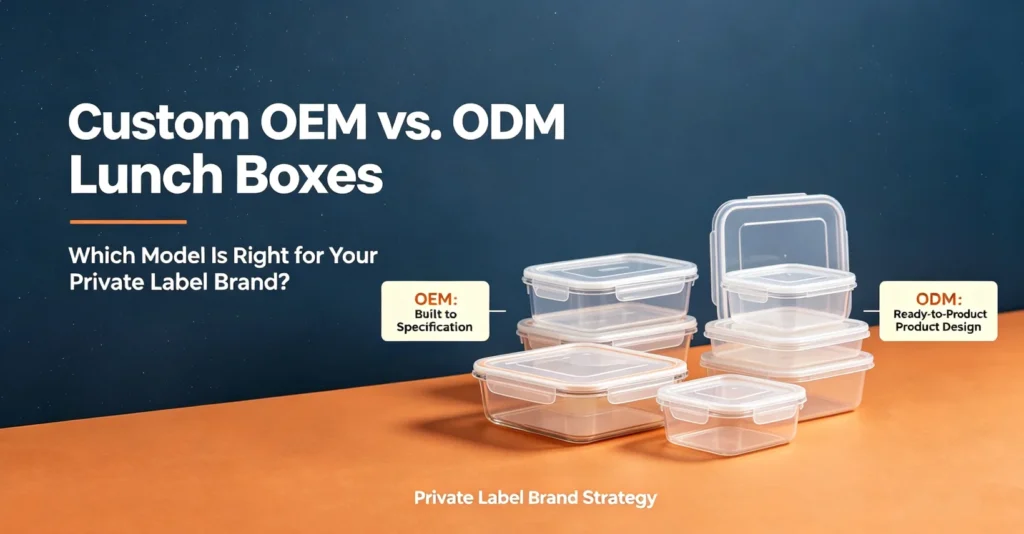
Understanding the Basics: OEM vs. ODM
What Is OEM (Original Equipment Manufacturing)?
In an OEM model, your brand provides the complete product design, engineering blueprints, 3D CAD files, and material specifications. The manufacturer acts strictly as a production partner, building custom injection molds or tooling to manufacture your proprietary design.
Your Role: Product design, engineering specs, market research, and branding.
Factory’s Role: Mold making, raw material sourcing, production, quality control, and assembly.
Example: You design a revolutionary, collapsible 3-compartment bento box with a patented child-safe latch system, and hire a factory to build your exclusive mold and produce it.
What Is ODM (Original Design Manufacturing)?
In an ODM model (often referred to as “private labeling” or “white-labeling”), the manufacturer designs, engineers, and tests the lunch box in-house. You select an existing product from their catalog and customize it with your logo, brand colors, custom packaging, and minor surface adjustments.
Your Role: Selecting catalog designs, branding, packaging customization, and marketing.
Factory’s Role: Complete product R&D, structural design, mold ownership, production, and certification compliance.
Example: You select an existing, market-proven 3-compartment glass bento box from a manufacturer’s catalog, print your brand logo on the silicone lid, design a custom color box, and launch it on your e-commerce store.
Head-to-Head Comparison: OEM vs. ODM
| Feature / Metric | Custom OEM Model | Catalog ODM Model |
| Intellectual Property (IP) | 100% Owned by Your Brand | Owned by the Manufacturer |
| Upfront Capital (NRE/Molds) | High ($3,000 – $25,000+ for steel molds) | Very Low to Zero (Molds exist) |
| Time-to-Market | 4 – 9 Months (Design, prototyping, tooling) | 4 – 8 Weeks (Sampling to shipment) |
| Product Uniqueness | Fully Unique / Differentiated | Shared base design (Common on marketplaces) |
| Minimum Order Quantity (MOQ) | High (Usually 3,000 – 5,000+ units) | Low to Medium (500 – 1,000 units) |
| Risk Level | Higher upfront financial risk | Lower risk, fast market testing |
Deep Dive: When to Choose Custom OEM
Developing a custom OEM lunch box requires substantial capital and patience, but it builds long-term brand equity and defensible market share.
Key Advantages of OEM
True Market Differentiation: You are not selling the same mold as five other Amazon sellers. Your product can solve unique customer pain points (e.g., custom compartment ratios, integrated utensil storage, or leak-proof sauce wells).
Defensible IP Rights: You own the design patents and utility patents. If a competitor attempts to copy your custom mold, you have legal grounds to remove their listings or block imports.
Higher Profit Margins at Scale: Once your upfront tooling/mold costs are amortized over tens of thousands of units, custom OEM production yields lower per-unit costs compared to ODM catalog items.
Challenges of OEM
High Tooling Costs: Custom plastic injection molds or metal stamping dies require significant capital expenditure upfront.
Extended Development Cycles: Rapid prototyping (3D printing), functional T1/T2 mold testing, drop testing, and FDA/LFGB certification checks add months before mass production begins.
Best For: Established brands, well-funded startups, or businesses with a patented product feature entering high-volume retail or e-commerce distribution.
Deep Dive: When to Choose Catalog ODM
If speed, cash flow, and low-risk market validation are your main priorities, ODM is the most efficient gateway into the housewares market.
Key Advantages of ODM
Fast Market Entry: Skip the lengthy 3–6 month mold-building phase. You can go from sample approval to full production in weeks.
Low Upfront Capital: Because the factory already owns the tooling, your initial investment goes directly toward inventory and custom branded packaging.
Proven Quality & Compliance: Established ODM catalog products have already undergone factory drop tests, thermal leak tests, and material certifications (FDA, LFGB, BPA-free).
Challenges of ODM
Market Saturation & Price Wars: Other sellers can order the exact same lunch box structure from the same factory. You will rely heavily on marketing, branding, and packaging to differentiate.
Limited Structural Control: You cannot easily alter compartment sizes or lid mechanisms without triggering a costly mold modification charge.
Best For: Amazon FBA sellers testing a new niche, boutique brands adding housewares as an accessory line, or corporate promotional gift buyers working on tight deadlines.
How to Choose: Decision Framework for Your Brand
To determine which manufacturing route fits your business, ask your product team the following 4 questions:
What is your upfront product development budget?
- If under $5,000, stick to ODM. Focus your capital on custom branding, premium packaging, and marketing.
- If over $15,000–$30,000, evaluate OEM to create an exclusive, patent-protected product.
How urgent is your product launch date?
- If you need inventory ready for the upcoming Back-to-School season in 60 days, ODM is your only viable path.
- If you are planning a strategic product launch 6 to 12 months out, OEM gives you room for full R&D.
Do you have a unique functional design or patent?
- If your lunch box solves a specific problem through a new mechanism, partition layout, or material mix, choose OEM to protect and monetize your invention.
What is your target distribution channel?
Large retail chains (e.g., Target, Walmart, Carrefour) often prefer unique, OEM-exclusive SKUs. Small e-commerce storefronts can succeed quickly using customized ODM catalog items.
The Hybrid Approach: Customizing ODM (The “Semi-OEM” Strategy)
Many successful housewares brands start with a hybrid approach.
You select an existing factory ODM base mold (to avoid full tooling costs), but negotiate a custom mold insert—such as a custom-designed silicone top lid, unique colorways, or a proprietary removable divider. This gives your private label brand distinct visual and functional differentiation at a fraction of full OEM development costs.
Partner with EasyLife — a Verified Lunch Box Manufacturer
Whether you decide to build a custom OEM mold from scratch or private-label an established ODM bestseller, choosing a manufacturer with in-house tooling capabilities, strict QC labs, and food-grade compliance (FDA/LFGB) is vital to your success.
Contact our engineering team today to review your 3D design files for OEM production, or request our latest 2026 ODM Product Catalog and sample kit.
Conclusion
Navigating the choice between OEM and ODM ultimately comes down to your brand’s current capital, launch timeline, and long-term market strategy. If speed-to-market and minimal financial risk are your top priorities, launching with a customized ODM model lets you validate your niche quickly using market-proven designs. Conversely, if you have a proprietary functional design, a healthy R&D budget, and want to build a long-term competitive moat through exclusive IP protection, investing in a custom OEM mold is the definitive path forward.
Whichever route you choose, the key to private label success lies in partnering with an experienced, quality-focused manufacturing partner. By aligning your brand’s goals with the right production model, you can streamline your supply chain, deliver exceptional houseware products, and capture a profitable stake in the global lunch box market.