For kitchenware brands, Amazon private-label sellers, and retail merchandisers, a well-designed bottle of oil is an evergreen revenue driver. Fueled by the surge in home cooking, air-fryer adoption, and health-conscious meal prep, consumer demand for functional, countertop-worthy cooking oil dispensers continues to grow year over year.
Yet, anyone who has managed a kitchenware SKU knows the industry’s open secret: leakage and dripping are the #1 drivers of 1-star reviews and costly product returns.
From a physics and engineering standpoint, no liquid dispensing mechanism is completely immune to failure when poorly manufactured. Whether you are sourcing a gravity auto-flip dispenser, a fine-mist sprayer, a 2-in-1 spray and pour bottle of oil, or a traditional cruet, every design carries distinct performance trade-offs.
Choosing the right SKU for your retail line isn’t about finding a mythical “magic” mechanism—it’s about matching the right structure to your target sales channel and partnering with an OEM/ODM kitchenware manufacturer whose R&D team knows how to engineer those failure points out of the product.
Comparing the 4 Core Structures for a Wholesale Bottle of Oil Line
Before locking in your next purchase order, evaluate how the four dominant market structures perform across user experience, retail positioning, and technical risk.
We will present it to you in a table format so that you can understand it easily:
| Bottle Structure | Best Target Channel | Key Selling Points | Common Industry Pain Points |
| Gravity Auto-Flip Spout | E-commerce (Amazon/DTC), Modern Kitchen Brands | Effortless one-handed operation; high visual appeal in video ads | Hinge jamming with viscous oils; lid failing to seal tightly after repeated use |
| Fine-Mist Oil Sprayer | Health/Fitness Brands, Air Fryer Accessory Lines, BBQ | Precise calorie control; even coating for baking, roasting, and air frying | Nozzle clogging; oil seeping around the trigger; shooting a stream instead of a mist |
| 2-in-1 Spray & Pour Bottle | Mid-to-High-End DTC Brands, Gift Sets, Boutique Retail | High average order value (AOV); replaces two countertop clutter items | Complex dual-channel seals prone to cross-leaking if mold tolerances are loose |
| Traditional Pourer / Cruet | Brick-and-Mortar Retail, HORECA (Foodservice), Minimalist Brands | Lowest mechanical failure rate; timeless design versatility (glass, ceramic, steel) | Oil dripping down the bottle exterior (“neck-dripping”); dust exposure on open spouts |
A. Gravity Auto-Flip Oil Bottles
A gravity-activated bottle of oil remains a top performer on e-commerce marketplaces because it demonstrates instant value in a 3-second social media clip. When tilted, the counterweight opens the cap automatically; when set upright, it closes.
The Sourcing Catch: Cheap off-the-shelf molds use low-grade axle pins and poorly balanced counterweights. Over time, sticky residue builds up at the hinge, preventing full closure and leading to dust contamination or leaks if knocked over.
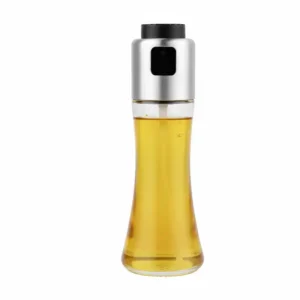
B. Oil Sprayers & Misters
As air fryers become standard countertop appliances, wholesale oil sprayers have transitioned from seasonal BBQ items to year-round essentials.
The Sourcing Catch: Atomizing viscous cooking oils is much harder than spraying water. Generic spray nozzles frequently clog or dispense a narrow jet stream rather than a wide-angle fan mist—triggering immediate customer dissatisfaction.
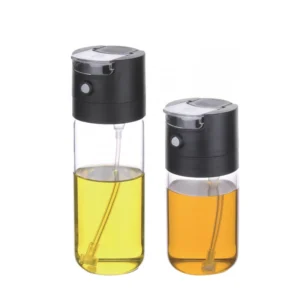
C. 2-in-1 Spray & Pour Oil Bottles
The 2-in-1 oil sprayer and pourer is currently one of the highest-margin innovations in the kitchenware space, allowing home cooks to switch seamlessly between pouring oil for stir-frying and misting oil for roasting.
The Sourcing Catch: Combining two distinct fluid pathways into a single cap requires precision engineering. Without strict silicone gasket tolerances, oil from the pouring spout migrates into the spray mechanism, causing messy seepage around the collar.
D. Traditional Pourers & Cruets
Classic glass and stainless steel oil cruets with weighted pour spouts, corks, or push-button lids remain staples for supermarket shelves and hospitality buyers.
The Sourcing Catch: While fewer moving parts mean fewer mechanical breakdowns, poorly angled spouts cause oil to curl back under the lip and run down the bottle—leaving greasy rings on marble countertops and dining tables.
Recommended products



Beyond the Cap: 3 Critical Sourcing Factors for B2B Buyers
Selecting the dispensing mechanism is only half of the product development equation. To protect your brand reputation and profit margins, evaluate these three manufacturing variables:
1. Bottle Material & UV Protection:
High-Borosilicate Glass: Lightweight, crystal-clear, and thermal-shock resistant. Its lighter weight reduces international freight costs and lowers breakage rates in e-commerce parcel shipping.
UV-Protected Amber/Dark Green Glass & 304 Stainless Steel: Essential if you are targeting gourmet culinary consumers or packaging a bottle of oil for Extra Virgin Olive Oil (EVOO), as UV light exposure accelerates oxidation and rancidity.
2. Transit Drop-Test Readiness:
For DTC and Amazon FBA sellers, fragile glass packaging can wipe out net margins. Ensure your supplier provides custom-molded pulp trays or high-density EPE foam inserts engineered to pass ISTA drop standards.
3. Food-Contact Compliance:
Every component touching oil—including PP/ABS caps, silicone gaskets, dip tubes, and glass bodies—must be BPA-free and fully compliant with FDA (US) and LFGB (EU) food-contact regulations.
The EasyLife Housewares Advantage: How Our In-House R&D Eliminates Leakage Pain Points
Most trading companies and basic factories simply pull existing public molds off the shelf, slap a logo on the glass, and leave brand owners to deal with the resulting customer complaints.
At EasyLife Housewares, we take an engineering-first approach to private label oil bottle manufacturing. Our dedicated in-house R&D and industrial design team continuously tracks global kitchenware trends—studying every best-selling structure on the market not just to replicate what works, but to fix what fails.
How We Engineer Lower Return Rates Into Every SKU:
Trend-Agility + Custom Private Molds: Whether you want to capitalize on a trending 2-in-1 oil dispenser silhouette or develop a completely proprietary design from scratch, our R&D engineers take your concept from 3D CAD prototyping to mass production rapidly.
Precision Silicone Gasket Calibration: Leakage most often happens at the neck threads. We custom-calibrate the Shore hardness and compression depth of our food-grade silicone seals so they create a tight, zero-seepage barrier across temperature fluctuations.
Anti-Drip Spout & Dual-Return Geometry: We refine spout lip angles and integrate internal oil-return channels so the last drop flows cleanly back into the reservoir rather than down the outside of the bottle.
Anti-Clog Atomization Engineering: For our oil sprayers, we optimize nozzle orifice geometry and internal filter meshes to deliver a consistent, wide-angle fine mist even with higher-viscosity culinary oils.
100% Pre-Shipment Leak & Vacuum Testing: Every production batch undergoes strict quality control protocols, including negative-pressure air-tightness testing and real-viscosity dispensing checks, drastically reducing your post-launch defect and return rates.
FAQ for B2B Oil Bottle Buyers
Which bottle of oil structure has the lowest return rate for Amazon and e-commerce sellers?
Traditional weighted-spout pourers generally have the lowest mechanical failure rate due to fewer moving parts. However, gravity auto-flip dispensers and 2-in-1 spray & pour bottles generate significantly higher conversion rates and revenue when sourced from a manufacturer with tight silicone seal tolerances and anti-drip spout engineering.
Can EL Housewares customize an existing trending oil bottle design with our brand’s unique look?
Yes. Our in-house R&D and design team offers full OEM and ODM services. We can modify exterior textures, custom-match Pantone colors for caps and glass coatings, apply silk-screen or laser-engraved logos, design retail-ready custom packaging, or build an exclusive private mold tailored specifically to your brand.
Why do oil sprayers often shoot a straight stream instead of a mist, and how do you prevent it?
Oil is roughly 30 to 50 times more viscous than water. Standard water-style atomizers fail to break up oil molecules under low finger pressure. Our R&D team designs specialized pressure-chamber nozzles and uses calibrated dip-tube filters that atomize cooking oils into an even, wide mist—provided users give a firm, full pump stroke.
What food-safety certifications do your wholesale oil dispensers meet?
All EL Housewares oil bottles and sprayers are manufactured using 100% food-grade, BPA-free materials (borosilicate/soda-lime glass, 304 stainless steel, food-grade silicone, and virgin PP/ABS) that meet FDA and LFGB standards. Full test reports are available upon request for retail compliance onboarding.
Can we request samples to test with different cooking oils before placing a bulk order?
Absolutely. We strongly encourage B2B buyers to test our bottles with olive oil, avocado oil, vegetable oil, and vinegar before committing to mass production. Contact our team to request a Sample Evaluation Kit.
Conclusion
Don’t let preventable leakage complaints hold back your brand’s growth or erode your marketplace margins. Partner with a manufacturer that combines trend-forward industrial design with rigorous leak-prevention engineering.
Selecting the right bottle of oil dispenser for your brand or retail line comes down to aligning the dispensing mechanism with how your customers actually cook and shop. While every structure—from gravity auto-flip spouts and fine-mist sprayers to versatile 2-in-1 designs and classic cruets—presents inherent engineering challenges, leakage and high return rates do not have to be the cost of doing business. By looking beyond generic public molds and partnering with an R&D-driven manufacturer like EL Housewares, you can turn an everyday kitchen staple into a reliable, high-margin hero product that earns 5-star reviews and lasting customer trust.