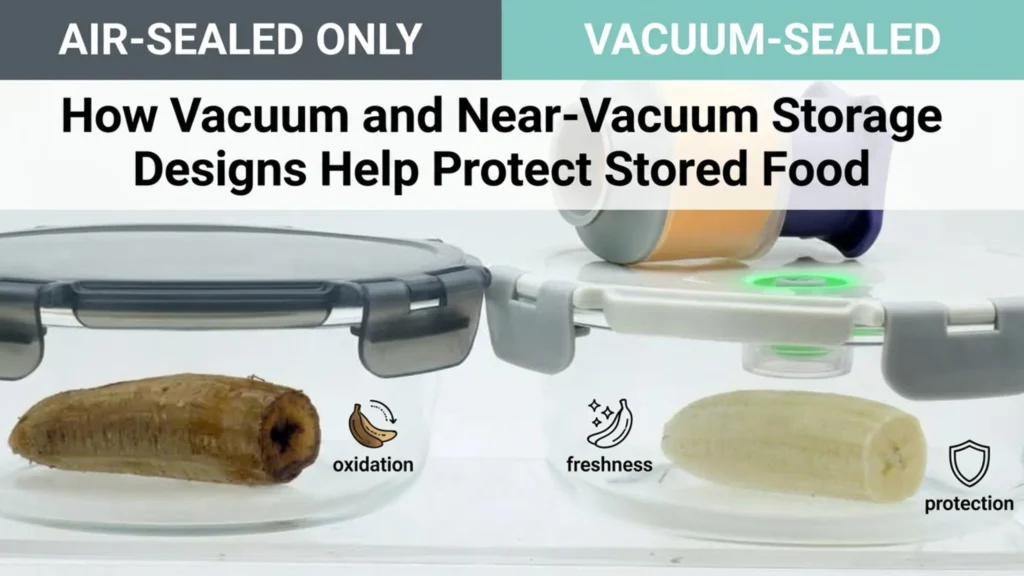
Vacuum food storage is often associated with keeping food fresh for longer. By removing or reducing the amount of air around stored food, vacuum and near-vacuum designs can help limit oxygen exposure, reduce air exchange, and protect the quality of certain foods.
But vacuum storage is not a one-size-fits-all solution.
Some foods can benefit from reduced air exposure, while fresh or highly perishable foods may require additional temperature and storage controls. Some fruits and vegetables can also respond differently to low-oxygen environments because they continue to respire after harvest.
For brands developing food storage products, understanding these differences is important. The goal is not simply to remove as much air as possible, but to create a practical storage environment that matches the food and the intended use.
What Is Vacuum Food Storage?
A standard airtight container seals food from the outside environment, but it still contains a normal amount of air inside.
A vacuum storage container goes a step further by removing a significant portion of that air. A near-vacuum design similarly reduces the amount of air inside the container, although it does not necessarily create a complete vacuum.
| Storage Design | Air Inside | Main Purpose |
|---|---|---|
| Standard container | Normal amount of air | Basic food storage |
| Airtight container | Air remains, with limited exchange | Helps isolate food |
| Vacuum container | Much of the air is removed | Reduces air exposure |
| Near-vacuum container | Air is significantly reduced | Creates a lower-air storage environment |
Reducing air can be useful because oxygen contributes to oxidation and can accelerate quality changes in many foods. USDA explains that vacuum packaging removes substantially all air before sealing and can help preserve food quality and flavor.
However, a household vacuum container should not automatically be treated as equivalent to commercial vacuum packaging or controlled-atmosphere storage. The actual level of air removal, sealing performance, temperature, food type, and storage time all matter.
How Does Reducing Air Help Protect Stored Food?
Reducing Oxygen Exposure
Oxygen can contribute to oxidation, which may affect the flavor, aroma, color, and overall quality of some foods.
Reducing the amount of air around food can therefore be useful for products such as coffee beans, nuts, grains, and other dry ingredients where oxidation can gradually affect quality.
The benefit is not that vacuum storage completely stops oxidation. Instead, it can help reduce the food’s exposure to oxygen compared with an ordinary container.
Helping Preserve Aroma and Flavor
Air exchange can also affect the aroma of stored food. Strong-smelling foods may release odors into the surrounding environment, while foods such as coffee and dry ingredients can gradually lose some of their characteristic aroma.
A well-sealed container with reduced air exchange can help create a more isolated storage environment.
This is one reason vacuum or near-vacuum storage can be interesting for products such as coffee, snacks, grains, and dry pet food.
Limiting Exposure to the Surrounding Environment
A properly sealed container can also help reduce exposure to outside odors, humidity, and repeated air exchange.
However, vacuum storage should not be confused with moisture-proof storage. The actual protection against moisture depends on the container material, lid, gasket, sealing structure, and storage conditions.
What Foods Can and Cannot Be Stored in Vacuum Containers?
This is where vacuum storage requires a little more attention.
Reducing air can be beneficial for some foods, but it does not automatically make every type of food last longer. In particular, fresh and moist foods require more careful handling.
Foods That Can Benefit From Vacuum or Near-Vacuum Storage
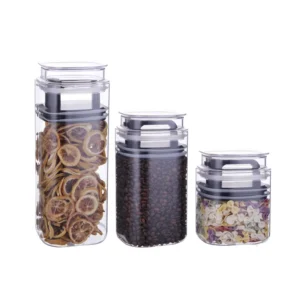
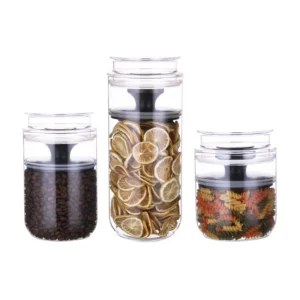
Vacuum or near-vacuum storage can be particularly useful for dry, low-moisture foods such as:
- Coffee beans, rice and grains
- Dried beans and legumes
- Nuts and seeds
- Dried fruits and vegetables
- Dry snacks
- Crackers
- Dry pet food
For these foods, reducing exposure to air can help protect quality and limit exposure to surrounding odors or moisture. USDA notes that vacuum packaging can extend the storage quality of dry, non-perishable foods such as nuts and crackers.
Foods That Need Extra Care
Fresh and moist foods are different.
Fresh meat, poultry, seafood, cooked foods, sauces, and other perishable foods may require refrigeration or freezing even when stored in a vacuum environment.
Removing oxygen does not make perishable food shelf-stable. In fact, reduced-oxygen environments can allow certain microorganisms, including Clostridium botulinum, to grow under suitable conditions. USDA therefore advises that perishable vacuum-packaged foods must be kept refrigerated or frozen.
For this reason, vacuum storage should always be considered together with proper food handling, temperature control, and storage time.
What About Fresh Fruits and Vegetables?
Fresh produce deserves a separate discussion because fruits and vegetables continue to respire after they are harvested.
They consume oxygen and produce carbon dioxide. Changing the atmosphere around them can therefore affect ripening, texture, flavor, and appearance.
Bananas are a good example. Research from UC Davis shows that bananas respond to controlled-atmosphere conditions, but excessively low oxygen or high carbon dioxide can cause undesirable texture and flavor.
This means that “less oxygen” does not automatically mean “better storage” for every type of produce.
Different fruits and vegetables have different respiration rates and responses to atmospheric conditions. Commercial controlled-atmosphere storage uses carefully managed oxygen, carbon dioxide, temperature, and humidity levels. A household vacuum container does not provide the same level of atmospheric control.
A Product Trial Insight: Why We Tested Bananas
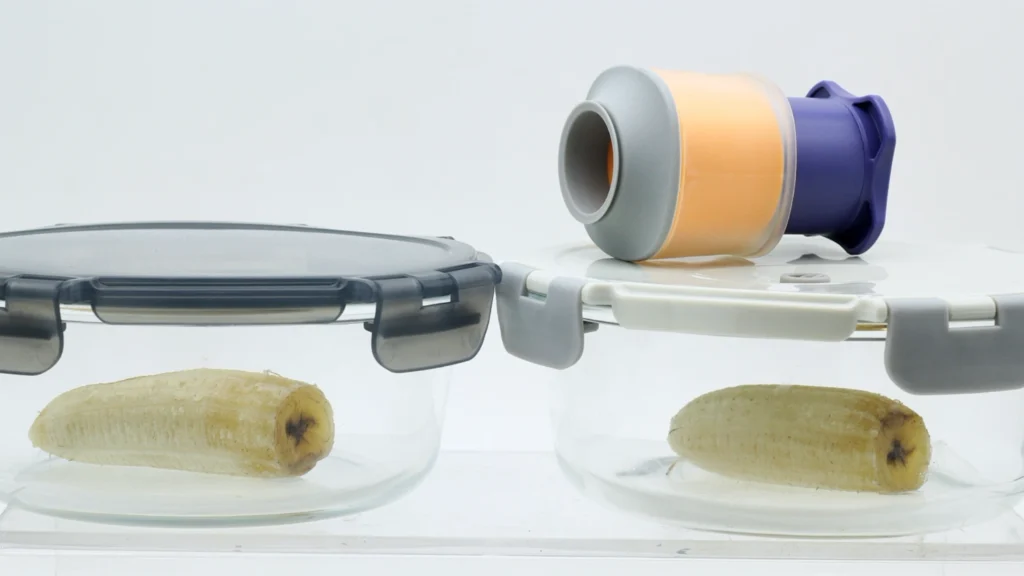
During one of our internal product trials, we compared bananas stored in a vacuum environment with bananas stored without vacuum.
Interestingly, the bananas in our vacuum test showed faster visible deterioration under our test conditions.
Rather than assuming that the vacuum container was simply “not working,” we looked further into how fresh produce responds to reduced-oxygen environments.
The result was an important product-development lesson:
Vacuum storage is not necessarily better for every type of food.
Research on bananas supports the idea that their storage behavior depends on the surrounding atmosphere, temperature, maturity, and other conditions. UC Davis reports that controlled-atmosphere storage can delay banana ripening under appropriate conditions, while excessively low oxygen can lead to undesirable quality changes.
Our test should therefore be viewed as a product trial under specific conditions, rather than a universal rule that vacuum storage always makes bananas deteriorate faster.
For product developers, however, this kind of testing is valuable because it shows why storage technology needs to be matched with the food being stored.
| Food Type | Vacuum / Near-Vacuum Suitability | Key Consideration |
|---|---|---|
| Coffee beans | Suitable | Helps reduce oxygen exposure and aroma loss |
| Rice & grains | Suitable | Low-moisture foods are well suited to sealed storage |
| Nuts & seeds | Suitable | Helps limit exposure to oxygen |
| Dry snacks | Suitable | Helps reduce air exchange and outside odors |
| Dry pet food | Suitable | Helps isolate food and contain odors |
| Fresh fruits | Use with care | Produce continues to respire |
| Fresh vegetables | Use with care | Atmospheric changes may affect quality |
| Cooked foods | Refrigerate or freeze | Vacuum does not make them shelf-stable |
| Meat & poultry | Refrigerate or freeze | Reduced oxygen does not eliminate microbial risks |
| Seafood | Refrigerate or freeze | Requires strict temperature control |
The key point is that vacuum storage should be treated as a storage technology, not a replacement for proper food preservation.
How Are Vacuum and Near-Vacuum Containers Designed?
The performance of a vacuum food storage container depends on more than simply removing air.
The truth is that there are several components work together.
Vacuum Mechanism
A vacuum or near-vacuum system needs a way to remove air from inside the container. Depending on the design, this may involve a pump, air-release valve, or other pressure-control structure.
Silicone Gasket
Once air has been removed, the container needs to maintain the reduced-air environment.
A well-designed silicone gasket helps create a reliable seal between the lid and container body.
Container Material
The container material also influences the product’s positioning and everyday usability.
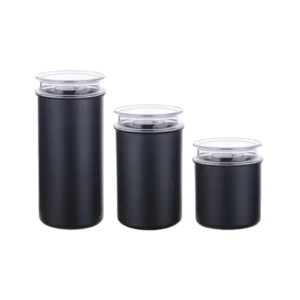
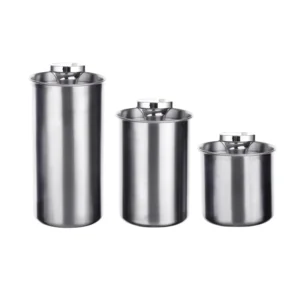
Stainless steel, for example, can provide a durable and opaque storage solution for foods that are sensitive to light or that have strong odors. It is also suitable for reusable food and pet food storage applications.
Recommended products

What Should Brands Consider When Developing Vacuum Food Storage Containers?
For kitchenware and houseware brands, the vacuum mechanism is only one part of the product.
Before selecting a supplier, consider:
- Vacuum performance: How much air can the system remove?
- Seal retention: Can the container maintain the reduced-air environment?
- Ease of use: Can consumers easily create and release the vacuum?
- Cleaning: Can the gasket and other components be removed and cleaned?
- Capacity: Are different sizes available for different food categories?
- Material: Is the container material suitable for the intended application?
- Packaging: Can the product be supplied with retail or custom packaging?
- Customization: Can the logo, color, or other details be customized?
- Testing: Can samples be provided for product trials before mass production?
A good product is not simply one that creates a vacuum. It should also be practical for repeated everyday use.

Choosing a Vacuum Food Storage Container Supplier
When sourcing vacuum or near-vacuum food storage containers, it is useful to look beyond the standard product catalog.
Ask the supplier about the vacuum mechanism, sealing structure, available capacities, materials, testing process, MOQ, and customization options.
For private label and B2B projects, you may also want to know whether the supplier can support custom logos, colors, packaging, OEM, and ODM development
A supplier that can support product testing and development can also help brands evaluate how a new storage design performs with different food categories before moving into mass production.
FAQ about Vacuum Storage
Does vacuum storage keep food fresh longer?
It can help slow certain quality changes by reducing exposure to air, but it does not guarantee longer storage for every type of food. Food type, temperature, moisture, hygiene, packaging, and storage time all affect how long food remains safe and acceptable.
Is vacuum storage the same as airtight storage?
No. An airtight container limits the exchange of outside air, while a vacuum container actively removes some or much of the air inside. Near-vacuum designs fall between these concepts depending on how much air is removed and retained.
Can I store fresh meat in a vacuum container?
Fresh meat should not be treated as shelf-stable simply because it is vacuum stored. USDA advises keeping vacuum-packaged perishable meat and poultry refrigerated or frozen. ask.fsis.usda.gov
Can fruits and vegetables be stored in vacuum containers?
Some produce may be stored in reduced-air environments, but results vary considerably by type, maturity, temperature, and atmospheric conditions. Fresh produce continues to respire, so vacuum storage is not automatically better for every fruit or vegetable.
What foods are well suited to vacuum storage?
Dry foods such as coffee beans, grains, nuts, seeds, dried foods, dry snacks, and dry pet food are generally more straightforward applications because their low moisture content reduces the risk of microbial growth.
Conclusion
Vacuum and near-vacuum storage can be useful tools for protecting the quality of certain foods, particularly dry ingredients and products that benefit from reduced exposure to air.
But the best storage design depends on the food. Our own banana product trial was a good reminder that reducing air is not automatically the right solution for every fresh food.
For brands developing vacuum food storage products, the container, sealing system, material, capacity, and intended food application all need to be considered together.
At EasyLife Housewares, we work with brands and buyers on food storage products from product selection and sampling to customization and packaging. If you are looking for a vacuum or near-vacuum storage solution, send us your requirements and let’s talk about what works for your product line.