For private label brands, Amazon sellers, and houseware importers, there is one product defect that guarantees negative 1-star reviews and mass returns faster than anything else: a leaking lunch box.
Whether it is olive oil drenching a business professional’s laptop bag or beet juice leaking into a child’s backpack, poor seal performance destroys brand reputation overnight.
While many trading companies promise “100% leak-proof” containers, true airtight performance is not an accident—it is the result of precision mold engineering, material selection, and rigorous factory testing.
Here is an inside look at how a tier-one lunch box manufacturer engineers, manufactures, and tests lunch boxes to achieve absolute airtight sealing. Including information on how Easylife conducts tests regarding leak prevention measures.
1. Dual-Injection Molding: Integrated vs. Removable Seals
The foundation of a leak-proof container starts with how the silicone seal is integrated into the lid. Modern OEM factories utilize two primary seal architectures:
- Removable Food-Grade Silicone Gaskets: Traditional designs use a removable silicone ring fitted into a perimeter groove. While cost-effective, bad groove tolerances can cause the gasket to slip, twist, or trap bacteria if not properly washed.
- Liquid Silicone Rubber (LSR) Overmolding: Premium manufacturers use 2K (Two-Shot) Injection Molding. The plastic lid and the silicone seal are fused together during the molding process into a single, seamless piece.
Factory Insight: Integrated LSR seals completely eliminate gaps where liquids can seep or mold can grow. They prevent the silicone from stretching out over time, ensuring the lid retains its airtight compression force through thousands of uses.
2. Multi-Point Latching Systems & Hinge Tolerance
A high-quality silicone gasket is useless without uniform downforce. If a lid only clamps down on two sides, the unlatched corners will bow slightly under pressure, causing liquid to escape when turned sideways.
To guarantee a 100% leak-proof rating:
- Perimeter Pressure Distribution: Engineers calculate the exact latch placement so that downward force is distributed evenly across all edges—and crucially, along the internal compartment walls.
- Individually Sealed Compartment Ribs: Top-tier 3-compartment bento boxes feature raised inner ribs on the lid that align precisely with the lower dividers. Each section seals independently, preventing sauce from section A from bleeding into section B.
3. Inside the Quality Control Lab: The 4 Critical Leak Tests
Before bulk production leaves the factory, representative samples from every injection mold run must pass four standardized lab tests:
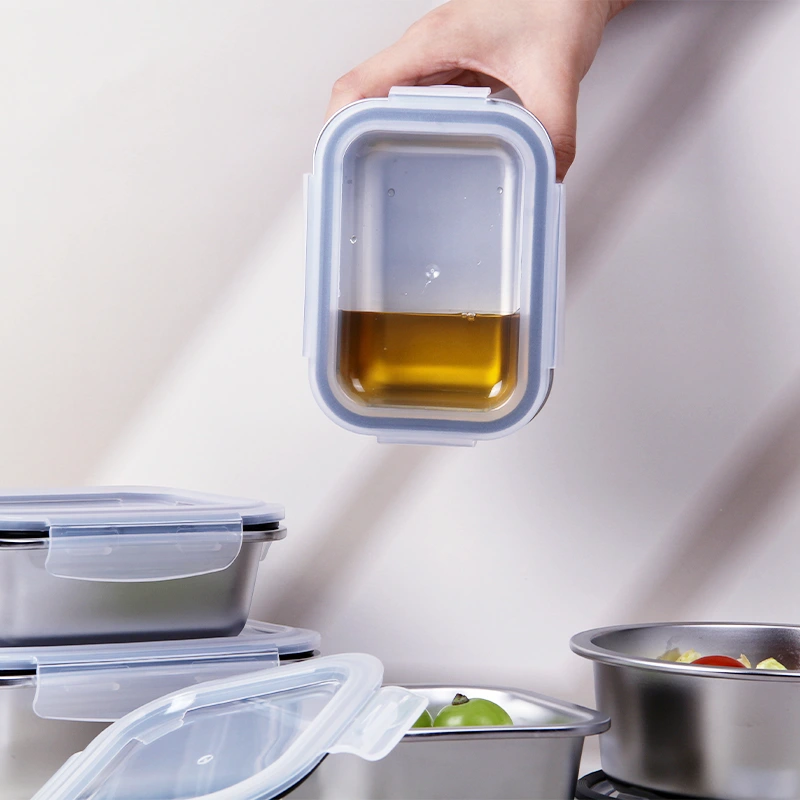
Test A: The Inversion & Tilt Test (Liquid Retention)
Containers are filled to maximum capacity with colored water, latched, and placed on an automated rotary rig. The lunch box is inverted 360 degrees and held at various angles for 24 hours to check for micro-droplet seepage.
Test B: Thermal Shock Vacuum Testing
Temperature changes alter internal air pressure, which often causes inferior seals to fail. Containers are filled with hot liquids (80°C / 176°F), sealed, and placed in a vacuum chamber. The pressure differential tests whether the seal buckles when internal steam cools and creates a vacuum inside the box.
Test C: Hinge & Latch Fatigue Testing
A robotic arm opens and snaps the lid latches closed for 5,000 to 10,000 continuous cycles. The container is then re-tested for leaks to verify that the plastic latches have not lost their clamping tension.
Test D: Dishwasher Deformation Resistance
Containers undergo 50+ high-heat commercial dishwasher cycles. Technicians use digital calipers to measure lid warping down to the millimeter. If the plastic warps even 0.5mm, the seal compression is compromised, and the mold parameters are recalibrated.
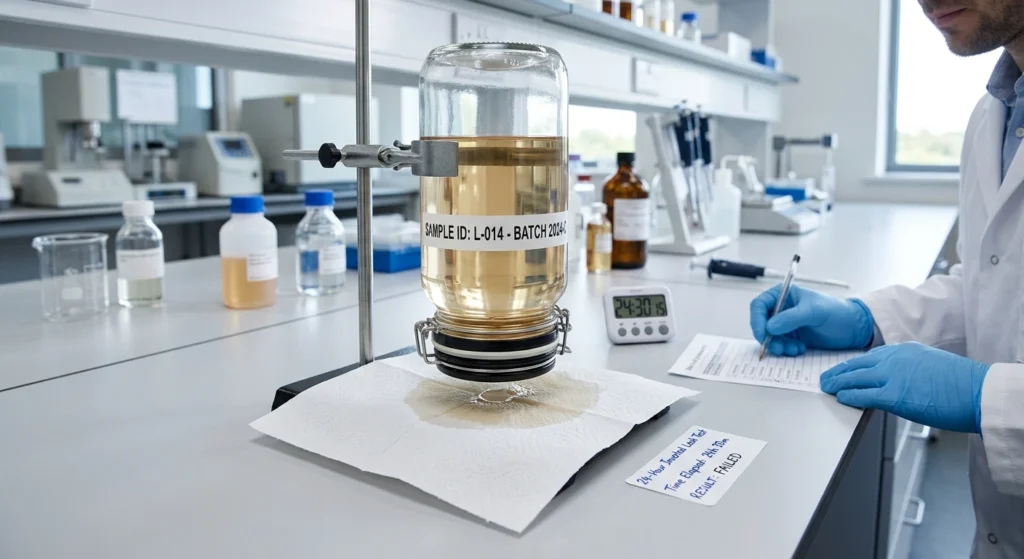
Test E: Inverted test
Usually, EasyLife will conduct inverted testing on specific samples. A piece of toilet paper is placed on a table and left in an inverted position for more than 24 hours, in order to check whether any liquid leaks onto the toilet paper.
What Importers Should Look For
When inspecting lunch box manufacturers or requesting OEM/ODM production samples, ask your factory for the following proof of quality:
- IPX rating or internal leak-test reports verifying performance with low-viscosity liquids (water/oil, not just thick sauces).
- Food-grade certification showing the silicone gaskets are 100% FDA and LFGB compliant.
- Replacement parts availability if sourcing removable gasket designs for mass production.
Partner with a Quality-First Manufacturer: EasyLife Housewares
A truly leak-proof lunch box requires precision engineering from the raw resin to the final pack-out. By choosing a manufacturer that invests in multi-shot molding technology and stringent factory QC testing, you protect your brand from costly customer returns and build a product line known for long-term reliability.
Contact our engineering team to request factory test reports or order sample kits for your private label line.
Conclusion
In the competitive housewares and private-label market, a single leaking container can destroy customer trust and erode your profit margins through costly returns. Achieving a true 100% airtight seal isn’t about luck—it demands precision-engineered molds, high-grade silicone integration, and uncompromised factory testing.
By partnering with a manufacturer that prioritizes rigorous quality control and advanced dual-injection molding, you ensure your product line delivers on its promise. Investing in leak-proof engineering protects your brand’s reputation, earns rave reviews, and secures a loyal customer base for years to come.